

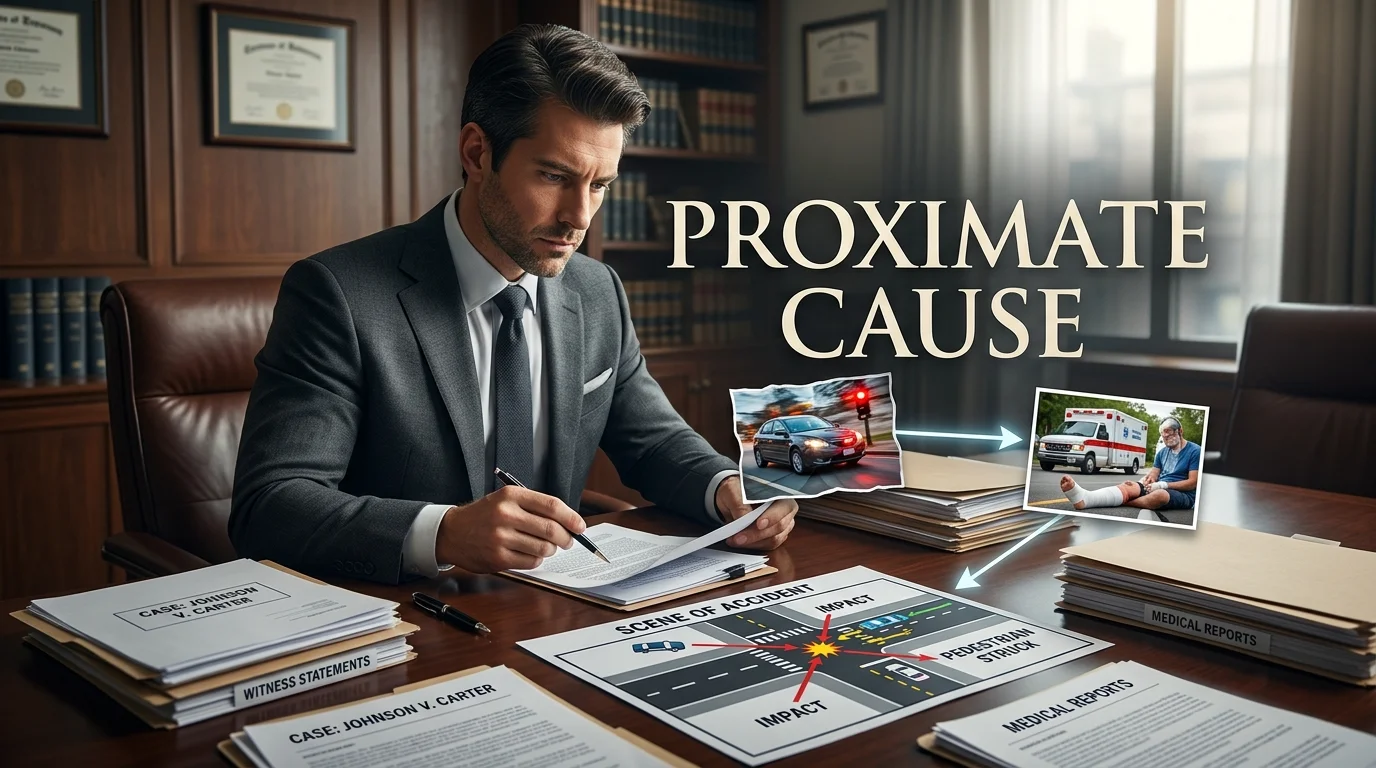
Proximate cause is the legal link between wrongful conduct and an injury that the law considers sufficiently connected. It limits liability when factual causation extends too far through remote events. In U.S. negligence cases, courts often examine foreseeability, directness, and later events before assigning legal responsibility.
Direct answer: Legal causation asks whether an injury is closely enough connected to a defendant’s conduct to justify liability. The harm usually must fall within a reasonably foreseeable risk created by that conduct. A remote or extraordinary later event can sometimes break the chain.
| Key point | What it means |
|---|---|
| Actual causation | The harm would not have happened without the conduct. |
| Legal causation | The connection is close enough for the law to impose responsibility. |
| Foreseeability | The general type of harm was reasonably predictable from the risk created. |
| Intervening event | A later event enters the sequence between conduct and injury. |
| Superseding event | An extraordinary later event may cut off responsibility for the earlier conduct. |
| State variation | Terminology and jury instructions differ across U.S. jurisdictions. |
Key takeaways
- Negligence usually requires both factual causation and a legally sufficient connection to the injury.
- Foreseeability is a common way to decide whether liability extends to a particular harm.
- A later event does not automatically end liability merely because it occurred after the defendant’s conduct.
- More than one person or event can legally contribute to the same injury.
- State law controls the exact test, wording, burdens, and jury instructions in a real case.
What the doctrine means in U.S. law
The doctrine places a legal boundary around the consequences of negligent conduct. Factual chains can stretch backward through many events, including remote conditions with little practical connection. Courts therefore ask whether the defendant’s conduct remains close enough to the injury for legal responsibility.
According to Cornell’s Legal Information Institute, a proximate cause is an actual cause that is also legally sufficient to support liability. That distinction prevents every factual contributor from becoming a defendant. Readers can browse the Newsprest Law section for related explanations of U.S. legal terms.
Actual cause and legal cause are different questions

Actual cause usually asks whether the injury would have happened without the defendant’s conduct. Lawyers often call this the but-for test. If the injury would have occurred anyway, that conduct may fail the factual causation requirement.
Legal cause asks a narrower responsibility question after factual causation is shown. A defendant can be part of the factual sequence without being legally responsible for every later consequence. The law uses this second inquiry to prevent liability from extending indefinitely.
| Question | Actual cause | Legal cause |
|---|---|---|
| Main focus | Did the conduct help produce the injury? | Is the connection legally close enough? |
| Common test | But-for causation | Foreseeability, directness, or another jurisdictional test |
| Problem addressed | Whether the conduct mattered factually | Whether responsibility should extend to this harm |
| Possible result | Several factual causes may exist | Only legally sufficient causes support liability |
How U.S. courts test proximate cause
No single nationwide formula applies to every tort case. State courts use different wording, and legal terminology is not uniform across jurisdictions. Two recurring ideas are foreseeability and whether the conduct significantly contributed to the harm.
Foreseeability
Foreseeability asks whether the general type of harm was a reasonably predictable result of the defendant’s conduct. The exact sequence does not always need to be predicted beforehand. The key question is whether the injury falls within the risk the conduct created.
A driver who runs a red light creates an obvious risk of collision. Injuries from the resulting crash are ordinarily within that risk. A distant event involving several unrelated decisions may be too remote for the same conclusion.
Substantial contribution and directness
Some courts or legal explanations also ask whether the conduct was a substantial factor in producing the injury. This idea separates meaningful contributors from trivial background conditions. The precise role of this language depends on the jurisdiction and claim involved.
Directness can matter because long causal sequences create more opportunities for independent events to change the outcome. Time and distance are not automatic cutoffs. Courts examine how the sequence developed and whether the later harm remained connected to the original risk.
Intervening and superseding events
An intervening event occurs after the defendant’s conduct but before the plaintiff’s injury. Its existence does not automatically erase the earlier causal connection. A foreseeable later event can leave the original actor legally responsible.
A superseding event is different because it can break the chain of legal responsibility. Courts often focus on whether that later event was extraordinary or unforeseeable. The facts and governing state law determine whether the earlier conduct remains legally significant.
A simple negligence example
Assume a driver texts while approaching a busy intersection and runs a red light. The driver strikes another vehicle, and the other motorist suffers a broken wrist. The careless driving is both a factual contributor and a foreseeable source of collision injuries.
Now assume a week later, an unrelated criminal act damages the injured person’s parked replacement vehicle. The earlier crash is part of the person’s recent history, but that connection is remote. The criminal act would likely require its own causation analysis under the applicable state law.
This comparison shows why causation needs two separate questions. Factual history can connect events that the law does not treat alike. Legal responsibility depends on the jurisdiction’s risk, sequence, and rules.
Palsgraf shows why foreseeability can be difficult
Palsgraf v. Long Island Railroad Co. remains a famous American tort case involving an unexpected chain of events. Railroad employees helped a passenger board a train, and a package containing fireworks fell. The explosion eventually injured a woman standing farther along the platform.
The New York Court of Appeals majority focused primarily on duty and the foreseeable range of danger. Judge Andrews’s dissent discussed the problem through legal causation and remoteness. That distinction matters because summaries sometimes treat the entire decision as one simple causation rule.
The case still illustrates the boundary problem at the heart of negligence law. Courts must decide where responsibility ends when consequences become unexpected or remote. The answer can depend on how a jurisdiction organizes duty, causation, and risk analysis.
Why legal causation matters in a negligence claim
A negligence plaintiff generally must connect a breach of duty to the injury being claimed. Evidence of careless conduct alone does not prove that the conduct caused every alleged loss. Causation can therefore become a central dispute when several events or medical conditions are involved.
Serious injury cases often require detailed records showing how an accident produced specific physical and financial consequences. Newsprest’s spinal cord injury lawyer guide explains how lawyers may investigate fault, medical evidence, and long-term losses. Those issues often depend on both factual and legal connections.
Can more than one legal cause exist?
Yes, more than one legally sufficient cause can contribute to the same injury in many jurisdictions. One actor does not always escape responsibility because another person also contributed. Comparative fault and allocation rules can then affect how courts divide responsibility.
The exact treatment varies by state and claim type. Some cases involve concurrent negligent acts, while others involve a later intervening event. Courts examine each actor’s connection to the injury under the governing rules.
What evidence can matter in a causation dispute?
Causation disputes are fact-specific, so the useful evidence depends on the event and alleged injury. Records can help show timing, sequence, and whether another event changed the outcome. Expert testimony may also be needed when medical or technical issues exceed ordinary knowledge.
| Evidence | What it may help establish |
|---|---|
| Accident reports, photographs, and videos | The event sequence and physical conditions |
| Medical records | Diagnosis, treatment, timing, and prior conditions |
| Witness statements | What happened before, during, and after the event |
| Vehicle or maintenance records | Whether equipment problems contributed to the injury |
| Expert analysis | Medical, engineering, reconstruction, or technical causation issues |
Settlement discussions can raise separate evidence rules that should not be confused with causation. Newsprest’s without prejudice meaning guide explains how settlement language works differently across legal settings. Those rules concern evidence and procedure, not the causal link itself.
State law can change the analysis
U.S. tort law is largely state-based, so terminology and jury instructions vary. Some courts emphasize foreseeability, while others use different formulations for legal causation. A state may also assign parts of the issue to judges, juries, or both.
That variation makes nationwide definitions useful only as a starting point. A real claim should be checked against the law governing the accident and lawsuit. Current state statutes, cases, and pattern jury instructions can control the final analysis.
Frequently asked questions
What is proximate cause in simple terms?
It means the law considers a defendant’s conduct closely enough connected to an injury to support responsibility. The connection usually involves a foreseeable risk rather than a remote coincidence. State law supplies the exact test used in a particular case.
Is legal cause the same as actual cause?
No, they answer different questions in a negligence analysis. Actual causation asks whether the harm would have happened without the conduct. Legal causation asks whether responsibility should extend from that conduct to the injury claimed.
Does an intervening event always break the chain?
No, a later event can intervene without ending the earlier actor’s responsibility. Foreseeable developments often remain within the original risk. An extraordinary superseding event is more likely to cut off the earlier connection.
Can there be several legally responsible causes?
Yes, several acts can contribute to one injury and remain legally significant. Courts may then apply comparative fault or other allocation rules. The result depends on the state, claim, and facts.
Who decides legal causation?
The answer depends on the jurisdiction and whether the facts are disputed. Juries often decide factual causation issues under court instructions. Judges may resolve questions when the connection is legally too remote.
What to do with a real injury or negligence question
Start by identifying the conduct, injury, and events connecting them in chronological order. Then separate factual causation from the question of legal responsibility. This approach helps reveal where a dispute about foreseeability or a later event may arise.
For an actual claim, check the law of the state governing the dispute before relying on a general definition. Filing deadlines and proof rules can differ sharply between jurisdictions. A licensed attorney can apply the controlling law to the specific facts and available evidence.
