


A disagreement with a landlord can quickly become more than an uncomfortable conversation when your housing, money, safety, or rental record is at risk. A tenant lawyer can explain the law that applies where you live, assess your lease and evidence, negotiate with a landlord, and represent you when a dispute reaches court. Because landlord-tenant rules differ significantly among U.S. states and cities, getting advice based on your specific location can be especially important when deadlines or an eviction are involved.
You do not necessarily need an attorney for every late repair or misunderstanding about a lease. Many routine problems can be resolved by documenting the issue, reviewing the rental agreement, and communicating with the landlord or property manager in writing. However, situations involving eviction proceedings, discrimination, serious health or safety problems, retaliation, substantial financial losses, or complicated lease terms may justify speaking with a qualified landlord-tenant attorney.
Quick answer: A tenant lawyer is an attorney who represents renters in disputes involving eviction, leases, unsafe housing conditions, security deposits, discrimination, retaliation, rent issues, and other landlord-tenant conflicts. A lawyer can explain local law, negotiate a solution, prepare legal documents, raise available defenses, and represent a tenant in court when necessary.
| Tenant problem | When legal help may be useful |
| Eviction notice or court papers | As soon as possible, particularly if you plan to challenge the case |
| Major repair or habitability problem | When written repair requests have not solved a serious condition |
| Housing discrimination | When treatment may be connected to a federally or locally protected characteristic |
| Security deposit dispute | When a significant amount is withheld and local requirements may have been violated |
| Retaliation or harassment | When adverse action follows a complaint or exercise of tenant rights |
| Lease or fee dispute | When the contract is unclear or substantial money is involved |
| Subsidized housing problem | When voucher or public-housing rules add another layer of requirements |
What Is a Tenant Lawyer?
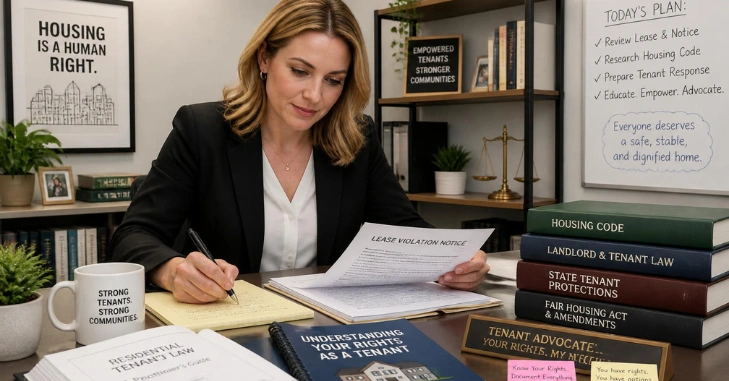
This kind of attorney usually practices landlord-tenant or housing law and focuses on the legal relationship between renters and property owners or managers. The lawyer may handle lease interpretation, eviction defense, repair disputes, discrimination allegations, security deposits, improper fees, privacy concerns, retaliation, and negotiations over moving out. Some attorneys exclusively represent tenants, while others practice broader real estate law or represent both sides in different matters.
The exact law governing a dispute depends heavily on location because rental housing is regulated through a combination of federal, state, and local rules. The Legal Services Corporation maintains an eviction-law database specifically because procedures and tenant protections differ across U.S. jurisdictions. Renters looking for broader legal explanations can also browse Newsprest’s Law section.
What Does a Tenant Lawyer Do?
A tenant lawyer attorney does more than appear in a courtroom. Depending on the problem and the attorney’s scope of representation, legal work can include reviewing the lease, analyzing notices, and identifying applicable state or local protections. It can also extend to communicating with the landlord, negotiating settlements, preparing court filings, gathering evidence, and representing the renter at hearings. The lawyer may also explain the practical consequences of different options so the tenant can make a more informed decision.
Typical services can include the following.
- Reviewing a lease, addendum, notice, or proposed settlement.
- Evaluating an eviction notice or court complaint.
- Identifying possible defenses to an eviction.
- Communicating or negotiating with the landlord or property manager.
- Addressing serious repair or housing-condition disputes.
- Seeking the return of a security deposit when legally appropriate.
- Evaluating possible retaliation or harassment.
- Reviewing possible housing-discrimination claims.
- Preparing responses, motions, evidence, or other court documents.
- Representing a tenant during hearings, mediation, negotiations, or trial.
- Advising tenants in public, subsidized, or voucher housing about applicable program rules.
Legal representation does not guarantee that a renter will win a dispute or remain in the property. A lawyer’s role is to evaluate the facts and governing law, identify realistic options, and advocate for the client’s position. The available remedies can vary widely depending on the state, city, lease, type of housing, and evidence.
7 Situations When You Should Consider Hiring an Attorney
1. You Received an Eviction Notice or Court Papers
An eviction is one of the strongest reasons to seek legal advice promptly because it can involve strict procedural requirements and court deadlines. HUD advises renters who receive an eviction notice to contact a local legal-assistance provider for advice, and nonprofit legal-aid organizations commonly handle housing cases. A lawyer can determine whether the landlord followed the correct procedure and whether defenses, settlement options, payment arrangements, or other remedies may be available under local law.
Do not assume that receiving a notice automatically means you must leave immediately, but do not ignore the document either. Eviction normally involves procedures established by state and sometimes local law, and missing a response or hearing can seriously weaken a tenant’s position. Keep the notice, envelope, lease, payment records, communications, and any court papers together so an attorney can review the complete timeline.
2. Serious Repairs or Unsafe Conditions Are Not Being Addressed
State and local laws commonly establish standards relating to the condition of rental housing, but the exact duties and remedies vary by jurisdiction. Problems involving loss of essential services, dangerous electrical conditions, major plumbing failures, structural hazards, pests, or other serious conditions can become legal matters when a landlord fails to respond appropriately. Tenants in HUD-assisted housing have additional program-related protections concerning decent, safe, and sanitary housing and timely repairs.
A housing attorney can help determine what legal remedies are actually permitted where you live rather than relying on advice from another state. This is especially important before withholding rent, paying for repairs and deducting the cost, terminating a lease, or taking another action that could have legal consequences. Document the condition with dated photographs, videos, written repair requests, inspection reports, and responses from management whenever it is safe to do so.
3. You Believe Your Landlord Discriminated Against You
Federal law provides important nationwide protections against housing discrimination. The Fair Housing Act prohibits housing discrimination based on race, color, national origin, religion, sex, familial status, or disability, while state and local laws may protect additional characteristics. A housing attorney can evaluate whether the facts potentially support a discrimination claim and explain whether federal, state, or local complaint procedures are appropriate.
HUD accepts reports of housing discrimination online, by telephone, and through other listed methods. HUD also states that a Fair Housing Act allegation generally must be filed within one year of the last alleged discriminatory act, although other legal deadlines and potential court claims can follow different rules. Because deadlines matter, renters who suspect serious discrimination should avoid delaying solely because they are still negotiating with the housing provider.
4. You Are Facing Retaliation or Serious Harassment
A dispute can become more serious when a tenant believes the landlord is retaliating because the renter reported a problem, complained to an agency, participated in a protected process, or exercised another legal right. The scope of anti-retaliation law varies, although federal fair-housing law specifically prohibits retaliation connected with protected fair-housing activity. HUD states that retaliation for making, assisting with, or participating in a housing-discrimination allegation is illegal.
Possible retaliation claims are highly fact-specific, so timing alone does not automatically prove that a landlord acted unlawfully. A lawyer can compare the landlord’s stated reason for an action with the chronology, lease, communications, inspection records, and relevant legal protections. Preserve texts, emails, letters, notices, photographs, witness information, and records of complaints made to management or government agencies.
5. Your Security Deposit Is Being Withheld
Security-deposit law is primarily governed at the state level, and rules may address permissible deductions, itemized statements, deadlines, notice requirements, interest, or possible penalties. An attorney can review whether the deductions comply with the law that applies to the property and whether the amount involved makes litigation or negotiation worthwhile. Some disputes can also be handled without full attorney representation, including through small claims court where permitted.
Start by comparing the landlord’s deductions with your move-in documentation, lease, move-out photographs, inspection records, and proof of rent payments. Ask for an itemized explanation when local law or the circumstances support doing so, and keep all correspondence in writing. Current legal guidance from Nolo likewise emphasizes documenting the rental’s condition and understanding state-specific deposit rules rather than assuming one nationwide standard applies.
6. You Have a Major Lease, Fee, or Rent Dispute
Rental agreements can contain provisions covering rent, late fees, utilities, pets, occupants, parking, repairs, renewal, termination, attorney fees, and many other obligations. When the financial stakes are substantial or the language is unclear, a lawyer can interpret the contract alongside state statutes and local ordinances. This can be particularly useful before signing a move-out agreement, repayment agreement, lease termination, or settlement that gives up important rights.
Settlement communications also deserve careful attention because legal labels do not always have the effect people assume. If a landlord, management company, or lawyer uses terms such as “without prejudice” during negotiations, the meaning depends on the legal context and jurisdiction. Newsprest explains this distinction in its guide to the meaning of “without prejudice.”
7. Your Case Involves Subsidized or Public Housing
Tenants participating in Housing Choice Voucher, public housing, or other federally assisted programs may have rights and responsibilities beyond those created by an ordinary private lease. HUD advises voucher tenants to document landlord problems and, when appropriate, contact their Public Housing Agency, local HUD office, tenant organizations, advocacy groups, or legal aid. These additional rules can make legal review especially useful when a dispute could affect both the tenancy and continued rental assistance.
Do not assume that advice written for an unsubsidized private rental applies automatically to federally assisted housing. Notice requirements, grievance procedures, inspections, rent calculations, and program obligations can differ depending on the assistance involved. An attorney or nonprofit housing advocate familiar with the specific program can help identify which set of rules governs the problem.
How Can an Attorney Help With an Eviction?
An eviction lawyer can begin by reviewing the landlord’s notice, lease, payment history, court complaint, and service documents. The attorney can then identify whether the case raises procedural problems, payment disputes, lease issues, discrimination, retaliation, repair-related defenses, or other arguments recognized by the relevant jurisdiction. If remaining in the property is unrealistic or undesirable, the lawyer may instead negotiate move-out timing, payment terms, dismissal language, or other settlement conditions.
Representation can also help tenants understand what is happening in court and what evidence is needed. LSC notes that eviction procedures vary substantially around the country and that unrepresented tenants can struggle with legal arguments, evidence, defenses, and procedural requirements. That makes early advice valuable even when a lawyer ultimately does not handle every part of the case.
How Much Does a Tenant Lawyer Cost?
There is no nationwide price for hiring a housing attorney because fees depend on location, complexity, urgency, the attorney’s experience, and the amount of work required. Some lawyers charge hourly rates, some offer a fixed fee for a defined service, and some provide a limited consultation or limited-scope representation. Certain statutory claims may have different fee arrangements, but tenants should never assume the opposing side will pay their attorney fees unless a qualified lawyer confirms that possibility under applicable law.
Before hiring someone, ask what the initial consultation covers and request a written explanation of the fee arrangement. Find out whether filing fees, service costs, expert expenses, or other case costs are separate from the lawyer’s professional fee. A clear engagement agreement can prevent a second dispute from arising over what legal services were included.
Can You Get Legal Help for Free?
Some renters can obtain free or low-cost legal help through nonprofit civil legal-aid programs, housing organizations, law school clinics, bar programs, or local right-to-counsel initiatives. The Legal Services Corporation funds 129 independent nonprofit legal-aid organizations serving every state, the District of Columbia, and U.S. territories, although eligibility and available services vary. LawHelp.org also provides state-by-state connections to nonprofit legal resources, including assistance for tenants facing eviction.
Demand for legal aid can exceed available capacity, so qualification does not necessarily mean an organization can accept every case. Apply as early as possible and contact more than one appropriate resource if necessary. You can also ask a local bar association about lawyer-referral programs or attorneys who provide limited-scope services.
How to Find a Good Tenant Lawyer
Start by looking specifically for an attorney with meaningful experience in landlord-tenant or housing law in the state where the rental property is located. A lawyer who regularly handles local eviction and tenant cases is more likely to understand the court procedures, housing codes, judges, filing rules, and practical settlement options relevant to the dispute. The American Bar Association notes that lawyer-referral programs can help people identify attorneys by area of law, while legal-aid directories can help eligible renters locate lower-cost assistance.
Questions worth asking include:
- How much of your practice involves representing tenants?
- Have you handled cases like mine in this city or county?
- What deadlines do you see in my documents?
- What are my strongest and weakest legal positions?
- What outcomes are realistically available?
- Will you handle the entire case or only specific tasks?
- Who will communicate with me day to day?
- What are your fees and additional case costs?
- What happens if the dispute settles?
- Are there lower-cost or legal-aid options I should consider?
A trustworthy lawyer should be willing to discuss both strengths and risks rather than promise a particular result. Be cautious about anyone who guarantees that an eviction will disappear, promises a certain monetary recovery before reviewing the facts, or pressures you into signing immediately. Legal outcomes depend on evidence, procedural history, applicable law, and decisions by courts or opposing parties.
What Documents Should You Bring to a Tenant Attorney?
Good documentation can help a lawyer understand the dispute faster and may reduce time spent reconstructing basic facts. Bring the most complete set of records you can reasonably collect, but do not delay urgent legal assistance simply because something is missing. Organizing documents chronologically can make the first consultation more productive.
Useful records can include the following.
- Current lease and all addenda.
- Renewal agreements.
- Eviction or termination notices.
- Court summonses, complaints, and hearing notices.
- Rent receipts and payment records.
- Security-deposit records.
- Letters, emails, and text messages with management.
- Repair requests.
- Photographs or videos of property conditions.
- Inspection or code-enforcement reports.
- Medical or other records relevant to a claimed housing condition, when appropriate.
- Witness names and contact information.
- Housing assistance or voucher documents.
- Proposed settlement or move-out agreements.
- A written timeline of important events.
Avoid altering screenshots, messages, photographs, or other potential evidence. Keep original documents whenever possible and create backups of important electronic records. Your attorney can determine what material is legally relevant and how it should be used.
What Should You Do Before Calling an Attorney?
The most useful first step is to identify whether there is an urgent deadline on a notice or court document. Next, gather the lease and create a short timeline showing what happened, when you notified the landlord, what response you received, and what happened afterward. Finally, write down the result you want, whether that means staying in the home, obtaining repairs, recovering money, ending the lease, clearing up a dispute, or negotiating additional time to move.
You should also avoid making irreversible decisions based solely on generic internet advice. Actions such as stopping rent payments, breaking a lease, changing locks, signing a settlement, or ignoring court papers can have consequences that depend on local law. A licensed attorney in the relevant jurisdiction can tell you which options are actually available in your circumstances.
For property-related information beyond legal disputes, readers can explore Newsprest’s Real Estate section. That resource can provide broader property context, while a tenant attorney remains the appropriate source for individualized legal advice. Keeping informational research and personal legal advice separate is especially important in high-stakes housing disputes.
Tenant Laws Are Different in Every State
There is no single U.S. landlord-tenant code governing every lease, eviction, repair dispute, rent increase, entry rule, or security deposit. State statutes form much of the legal framework, and cities or counties may add rent-control rules, eviction protections, inspection requirements, licensing laws, or other tenant protections. Federal laws then apply to particular issues such as housing discrimination and certain federally assisted housing programs.
This patchwork is why an online article cannot determine whether a particular landlord action is legal. Even two renters with similar problems may have different rights because they live in different states, cities, or types of housing. Use nationwide information to recognize potential issues, then check the rules where the property is located before taking legal action.
Final Thoughts
A tenant lawyer can be especially valuable when a rental problem threatens your housing, involves court proceedings, raises discrimination or retaliation concerns, creates serious health or safety issues, or puts substantial money at risk. The sooner a renter understands the applicable state and local rules, the easier it may be to preserve evidence, meet deadlines, and evaluate realistic solutions. Keep your lease and communications organized, take formal notices seriously, and seek qualified local assistance when the consequences are significant.
Frequently Asked Questions
What kind of lawyer handles tenant problems?
A landlord-tenant attorney or housing lawyer is usually the best starting point for an ordinary rental dispute. Depending on the facts, a civil-rights attorney, consumer lawyer, disability-rights lawyer, or another specialist may also become relevant. Ask whether the attorney regularly represents tenants in the specific type of dispute you have.
Should I get a lawyer if my landlord is evicting me?
Consider seeking legal help as soon as you receive an eviction notice or court papers, particularly if you intend to challenge the eviction. Deadlines and defenses vary by jurisdiction, and waiting can reduce the options available to you. HUD specifically recommends contacting a local legal-assistance provider after receiving an eviction notice.
Can I sue my landlord without a lawyer?
People are sometimes allowed to represent themselves, including in certain small claims and landlord-tenant proceedings, but the rules depend on the court and jurisdiction. Representing yourself can still require compliance with filing deadlines, evidence rules, service requirements, and other procedures. When your housing, a large amount of money, or a complicated legal claim is involved, even a limited consultation with a lawyer may help you understand the risks.
Can an attorney stop an eviction?
A lawyer cannot guarantee that an eviction will be stopped. Depending on the facts and local law, an attorney may identify defenses, challenge procedural defects, negotiate an agreement, request appropriate court relief, or help the tenant obtain additional time. The result ultimately depends on the evidence, governing law, procedural history, negotiations, and court decisions.
What if I cannot afford an attorney?
Check nonprofit legal aid before assuming that professional assistance is unavailable. LSC-funded organizations operate across the United States, and LawHelp.org can direct renters to state-specific legal resources and free or low-cost services. Availability and income requirements differ, so contact programs early when an eviction or other deadline is approaching.
Can I report housing discrimination without hiring a lawyer?
Yes, HUD provides a process for reporting suspected housing discrimination, and an attorney is not required simply to submit a report. HUD accepts reports online and by phone at 1-800-669-9777 and recommends acting promptly because filing deadlines apply. A lawyer can nevertheless be useful when the facts are complicated, substantial damages are involved, or you need advice about additional state or federal claims.
Does every tenant have a right to a free lawyer?
There is no nationwide automatic right to appointed counsel for every ordinary landlord-tenant case. LSC explains that the constitutional guarantee of legal assistance generally applies to criminal matters, while civil legal-aid organizations provide representation based on eligibility, funding, case priorities, and available resources. Some cities, states, or local programs have adopted broader tenant right-to-counsel protections, so renters should check the rules where they live.
