

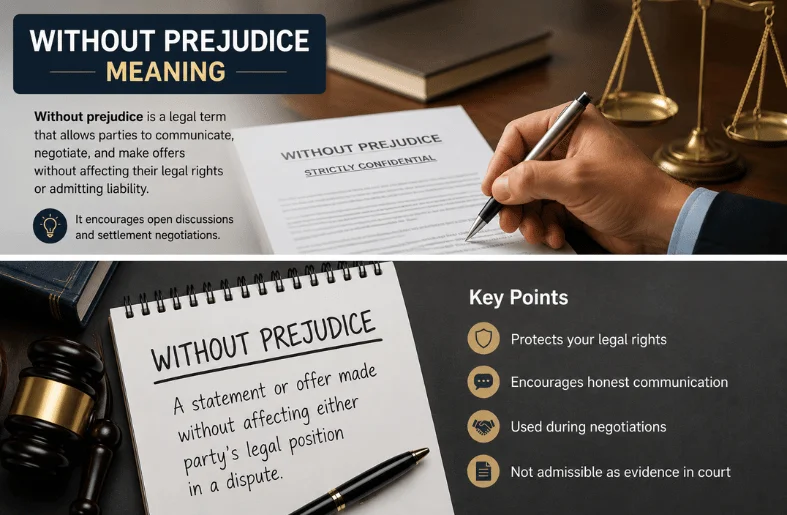
If you are searching for the without prejudice meaning, you have probably seen the phrase in a legal letter, settlement offer, email, or court document. Its effect depends on the context and the law that applies to the dispute.
“Without prejudice” means a legal communication or action is intended not to harm a party’s existing rights. In settlement talks, it can protect genuine efforts to resolve an existing dispute from being used as admissions. In a court dismissal, it can mean the claim may be brought again, subject to procedural rules and deadlines.
| Key point of Without Prejudice Meaning | What it means |
|---|---|
| Basic legal idea | Existing legal rights are preserved rather than permanently surrendered |
| Settlement negotiations | Genuine attempts to settle a dispute may receive evidentiary protection |
| The label itself | Writing “without prejudice” does not automatically protect a communication |
| Court dismissal | In the U.S., a dismissal on this basis may allow the claim to be filed again |
| Save as to costs | The communication may later be considered when legal costs are decided |
Key Takeaways
- The phrase commonly appears during settlement negotiations.
- Protection depends on the substance and circumstances, not the heading alone.
- Rules differ between countries and legal systems.
- A court dismissal uses the phrase differently from a settlement letter.
- Specific exceptions can allow settlement material to be considered later.
Readers looking for more general legal information can also browse the Newsprest Law section.
Without Prejudice Meaning in Settlement Talks
In England and Wales, the rule generally protects communications that form part of a genuine attempt to settle an existing dispute. It can cover written correspondence, meetings, phone calls, and other negotiations.
The purpose is practical. Parties often need to make compromises to settle a dispute. They may offer less money, accept part of another side’s argument, or suggest terms they would reject at trial. The rule helps them negotiate without treating every concession as an admission of liability.
The Law Society also notes that the nature and purpose of the communication matter more than the heading placed on it. For example, imagine an injured person claims $100,000 after an accident. The defendant offers $60,000 to end the dispute.
A settlement offer does not necessarily mean the defendant accepts legal responsibility for the accident. Newsprest’s guide to working with a spinal cord injury lawyer discusses how settlement negotiations can form part of a serious personal injury claim.
When Does the Protection Apply?
In UK dispute resolution, two factors are especially important:
- There must generally be an existing dispute between the parties.
- The communication must be a genuine attempt to settle that dispute.
ACAS applies these principles when explaining settlement discussions in employment matters. It also notes that protection can be affected where there has been “unambiguous impropriety.”
This means an ordinary business email is not automatically protected simply because negotiations might later lead to a disagreement. The exact test depends on the relevant country, court, and type of dispute. Legal rules should always be checked for the jurisdiction involved.
Does Writing “Without Prejudice” on a Letter Guarantee Protection?
No. A heading alone is not enough. Courts generally look at what the communication is doing. A document containing a genuine settlement proposal may receive protection even if the writer forgot to label it. A document labeled as a settlement may fail to qualify if it has nothing to do with settling a real dispute.
That distinction prevents people from using a legal heading to hide material that would otherwise be relevant. A sensible settlement letter should make its purpose clear. It should identify the dispute, explain the proposed resolution, and avoid assuming that a heading creates blanket confidentiality.
What Does “Without Prejudice Save as to Costs” Mean?
This variation has an extra purpose. A communication marked without prejudice save as to costs generally remains protected while the court decides the substantive dispute. It may be shown later when the court considers who should pay the legal costs. You might also like U.S. Trust Setup Costs.
Suppose one party makes a reasonable settlement offer and the other side rejects it. The case continues, but the final result is less favorable than the earlier offer. Depending on the applicable rules, the court may consider that offer when making its decision about costs. This is one reason parties take formal settlement proposals seriously.
Business disputes frequently involve contracts, payments, and negotiated resolutions. Readers interested in related topics can browse Newsprest’s Business section.
What Does a Dismissal Without Prejudice Mean?
The phrase has another important use in U.S. court procedure. A case that is dismissed without prejudice has generally not been permanently resolved on its merits. The claimant may be able to bring the claim again if procedural requirements and filing deadlines permit.
Federal Rule of Civil Procedure 41 provides that voluntary dismissal is treated this way in several situations unless the filing or a court order states otherwise. The rule also contains important qualifications, including provisions dealing with repeated dismissals.
| Court wording | General effect |
| Dismissed without prejudice | A later claim may still be possible |
| Dismissed with prejudice | The claim is generally treated as finally resolved |
| Settlement communication | Separate issue involving rules about negotiation evidence |
The ability to refile is not unlimited. Limitation periods, court orders, procedural rules, and the facts of the case can still prevent another action.
How the Rule Differs in the United States and the UK

The legal effect should not be assumed to be identical across jurisdictions. In England and Wales, the common-law settlement rule focuses heavily on genuine attempts to resolve an existing dispute. The substance of the negotiations determines whether the protection applies.
U.S. federal courts have a different framework. Federal Rule of Evidence 408 generally prevents settlement offers and statements made during compromise negotiations from being used to prove or disprove the validity or amount of a disputed claim. The rule also allows the evidence to be admitted for certain other purposes.
For that reason, Americans should not assume that adding a familiar legal phrase to an email creates an independent or unlimited privilege. The practical lesson is simple: identify the jurisdiction before relying on the wording.
How to Read the Phrase in 10 Seconds
If you receive a legal document containing the phrase, ask four questions:
- Is this a settlement discussion? Check whether the sender is proposing terms to resolve an existing dispute.
- What country or court is involved? The legal effect can change by jurisdiction.
- Does it say “save as to costs”? That wording may affect whether the communication can later be shown on costs.
- Is this a dismissal order instead? If so, the phrase may raise the question of whether the case can be brought again.
Do not treat the heading as permission to ignore the document. A settlement offer can still create deadlines, negotiation choices, or contractual consequences if accepted.
The Bottom Line
The phrase usually signals that a person wants to protect an existing legal position while negotiating, communicating, or taking a procedural step. It does not erase legal consequences or automatically make every document secret.
The context matters most. Check whether you are dealing with a settlement discussion, a costs-related offer, or a court dismissal. Then check the rules that apply in the relevant jurisdiction.
Frequently Asked Questions
It generally means that a legal step is being taken without permanently giving up or damaging existing rights. In settlement negotiations, the concept often limits the extent to which genuine compromise discussions can later be used as evidence.
Sometimes. Genuine settlement negotiations are often protected, but the rule is not absolute. Courts may consider the purpose of the communication, applicable exceptions, and the law of the jurisdiction. U.S. Federal Rule of Evidence 408 also permits settlement material to be used for certain purposes other than proving liability or the amount of a claim.
No. Confidentiality and evidentiary protection are related ideas, but they are not identical. A settlement communication can be restricted from use in certain court proceedings without creating a universal promise that no one can ever disclose it.
In U.S. dismissal terminology, “with prejudice” generally indicates a final resolution that prevents the same claim from being brought again. The alternative usually preserves an opportunity to refile, although procedural rules and deadlines still apply.
No. Use legal labels carefully. Their effect depends on the context, the existence of a dispute, the purpose of the communication, and local law. If the matter could affect substantial legal or financial rights, a qualified lawyer can advise on the correct wording.
