


Setting up an estate plan can protect property and make future transfers easier. Costs vary widely because legal needs, assets, and state rules differ. A simple revocable living arrangement usually costs much less than specialized planning.
Direct answer: For Americans asking how much does it cost to set up a trust, a typical attorney-drafted revocable living plan often costs about $1,000 to $4,000. Online or DIY options may cost roughly $30 to $500. Complex or irrevocable arrangements can cost several thousand dollars more.
| Setup option | Typical 2026 cost | Best suited for |
|---|---|---|
| DIY book or software | About $30–$350 | Simple estates and confident DIY users |
| Online estate-planning service | About $100–$500+ | Straightforward estates needing guided documents |
| Estate-planning attorney | About $1,000–$4,000+ | Customized planning and legal advice |
| Complex or specialized planning | $5,000+ in many cases | Businesses, tax planning, special needs, or unusual assets |
| Asset transfers and recording | Varies by state and county | Homes and other titled property |
Price ranges are planning estimates rather than fixed national fees. Nolo currently estimates roughly $1,000 to $2,000 for attorney assistance with a basic living arrangement. LegalZoom gives a broader attorney-prepared range of about $1,500 to $4,000.
Key takeaways
- Attorney-prepared plans usually cost more because they include personalized legal advice.
- Online services can reduce the upfront price for straightforward estates.
- Complex family, tax, business, or property issues increase legal fees.
- Funding the arrangement may create extra deed, recording, or professional costs.
- Professional management can create ongoing fees after the documents are signed.
- State law affects signing, property-transfer, and administration requirements.
How Much Does It Cost to Set Up a Trust in the U.S.?
There is no single national price because estate-planning needs vary. A straightforward revocable living plan usually falls toward the lower end. Complicated instructions, business interests, or multiple properties can push fees higher. Nolo says DIY resources can cost about $30 to $350. Its current guidance places average lawyer costs around $1,000 to $2,000. Location, attorney experience, and estate complexity can change the final quote.
LegalZoom reports a broader 2026 range of roughly $400 to $4,000 for revocable living planning. Its attorney-prepared estimates commonly range from $1,500 to $4,000. More complicated estates can exceed $5,000.
DIY and online options
A DIY approach has the lowest upfront cost. You prepare documents using software, forms, or an online guided service. This route may fit people with uncomplicated assets and family arrangements. Current online prices differ significantly between providers. Trust & Will lists its trust-based estate plan at $499 before optional attorney support. Nolo also offers lower-cost self-help options for eligible users. Lower cost does not remove the need for accurate documents. State rules and asset ownership still matter. A mistake may become difficult to correct after incapacity or death.
Hiring an estate-planning attorney
An attorney usually charges more because the service includes legal analysis. Many lawyers use a flat fee for common estate-planning packages. Others charge hourly when the situation requires substantial customization. A basic package may include several documents besides the main agreement. Common additions include a pour-over will and powers of attorney. Ask for a written list showing what the quoted fee covers.
Attorney assistance becomes more useful as complexity increases. Blended families, businesses, special-needs planning, and property in several states can create additional issues. Local counsel can explain rules that apply to your circumstances. Readers researching other legal topics can also browse Newsprest’s Law section. It covers U.S.-focused legal issues and related practical guidance.
What Does the Setup Price Usually Include?
A quoted fee does not always cover every task. Some attorneys quote an entire estate-planning package. Others quote only document preparation. Ask whether the price includes consultation, drafting, revisions, signing instructions, and follow-up work. You should also ask whether deeds or asset transfers cost extra. Comparing the scope matters as much as comparing the headline price.
The Consumer Financial Protection Bureau’s consumer guidance on revocable living trusts explains that a revocable living arrangement only controls property transferred into it. Property outside the arrangement remains outside the trustee’s authority. That makes funding an essential part of the process.
Funding can create extra expenses
Funding means transferring appropriate assets into the estate-planning structure. Real estate may require a new deed and county recording. Financial institutions may have their own account-retitling procedures. Recording fees vary by county and state. Legal assistance with deed preparation may also increase the bill. Ask specifically whether property transfers are included before hiring someone.
Property ownership can become especially important when several people share real estate. Newsprest explains inheritance implications in its guide to tenants in common ownership. That background can help homeowners identify questions before meeting an attorney.
What Factors Increase the Cost?
Complexity usually has the greatest effect on professional fees. An individual with one home may need less work than a business owner. Detailed tax or family provisions may require additional attorney time.
Common price factors include:
- Your state and local legal market.
- Whether the plan covers one person or a couple.
- The number and type of properties involved.
- Business ownership or complicated investments.
- Blended-family inheritance instructions.
- Special-needs beneficiaries.
- Asset-protection or advanced tax planning.
- The number of revisions required.
- Deed preparation and property-transfer work.
- Professional trustee or administration services.
These factors explain why national averages have wide ranges. Two households with similar net worth may still receive different quotes. Their assets and goals may require completely different legal work.
Revocable vs. Irrevocable Planning Costs
Revocable living arrangements are generally simpler to create. The person establishing one usually retains significant control during life. The IRS treats a revocable living arrangement as a grantor-type structure for federal tax purposes. Irrevocable arrangements are usually more complicated. Changing them can be difficult because the creator gives up powers defined by the governing documents and law. Tax, creditor, gifting, and beneficiary issues can require specialized advice. That added complexity often raises professional fees substantially. Complex planning may cost $5,000 or more, depending on the work involved. You should obtain a personalized quote for advanced planning rather than relying on national averages.
Are There Ongoing Costs After Setup?
A simple revocable plan managed by its creator may have limited annual expenses. Costs can rise when professionals manage investments or perform administrative duties. Future amendments can also require legal work. Tax preparation may become another expense in certain situations. Form 1041 rules depend on the type and tax status involved. The IRS’s Form 1041 guidance for estates and trusts sets out the separate reporting requirements for fiduciaries.
A professional trustee may also charge for management services. Fee structures vary between individuals and financial institutions. Request a written fee schedule before appointing a paid professional. For broader money-related reading, Newsprest maintains a Finance section covering personal and household financial topics. Estate decisions often overlap with taxes, property, and long-term financial planning.
Attorney vs. Online Service: Which Costs Less?
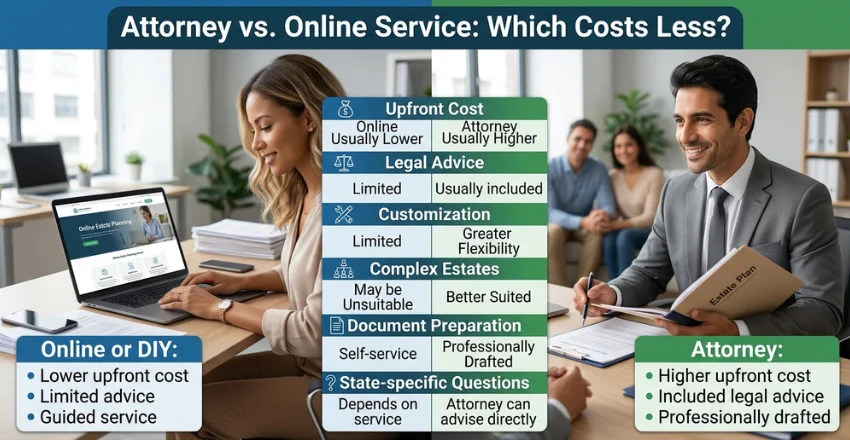
| Factor | Online or DIY | Estate-planning attorney |
|---|---|---|
| Upfront cost | Usually lower | Usually higher |
| Personalized legal advice | Limited or optional | Usually included |
| Custom provisions | Limited | Greater flexibility |
| Complex estates | May be unsuitable | Better suited |
| Document preparation | Guided or self-service | Professionally drafted |
| Funding assistance | Often limited | May be included |
| State-specific questions | Depends on service | Attorney can advise directly |
An online service may save money when your situation is straightforward. Attorney assistance costs more but provides individualized legal advice. The cheaper choice is not automatically the better choice for every household. Before comparing prices, compare exactly what each provider includes. A $500 package and a $2,000 attorney package may offer different services. Deed work, revisions, consultations, and companion documents can change the comparison.
A Simple Cost Example
Consider a homeowner with ordinary bank accounts and two adult beneficiaries. A lawyer might quote a flat estate-planning package in the low thousands. Additional deed work could increase the total. Now consider someone owning several rental properties and a business. Their instructions may require more drafting and tax coordination. That additional work can move costs well beyond a basic package.
Property owners can browse Newsprest’s Real Estate section for related property topics. Ownership structure can affect the questions you bring to an estate-planning professional. Individual legal advice should still come from a qualified professional.
How to Keep Setup Costs Under Control
You can reduce avoidable expenses by preparing before requesting quotes. Clear information helps providers understand the work involved. It also makes competing estimates easier to compare.
- List your major assets. Include real estate, financial accounts, businesses, and valuable personal property.
- Identify your beneficiaries. Decide who should receive property and under what circumstances.
- Choose possible trustees. Consider both family members and professional options.
- Request written quotes. Ask whether pricing is flat-rate or hourly.
- Compare included documents. Check whether wills and powers of attorney are part of the package.
- Ask about funding. Confirm whether deed preparation or account-transfer help costs extra.
- Clarify revision policies. Find out whether minor changes are included after signing.
Do not choose a provider based only on the cheapest advertised amount. Compare experience, services, and the complexity of your situation. A clear written scope can prevent surprise charges later.
When Paying for an Attorney May Make Sense
Professional advice deserves stronger consideration when your situation has unusual legal or tax issues. Examples include blended families, special-needs beneficiaries, businesses, or property in several states. Advanced tax planning also warrants individualized guidance.
An attorney can explain how local law affects your plan. They can also identify issues that a standard questionnaire may not reveal. This guidance can matter when mistakes would be expensive to correct.
Is the Cost Worth It?
The value depends on your goals rather than one specific net-worth threshold. The CFPB notes that revocable living arrangements can help control property and avoid probate for funded assets. They can also provide management instructions if the creator becomes unable to manage property.
Probate procedures and costs vary by state. Some households may have simpler alternatives for transferring certain assets. Beneficiary designations and survivorship ownership can also affect estate planning. A local attorney can compare those alternatives for your situation. The goal should be appropriate planning rather than creating documents you do not need. Paying more only makes sense when the extra service addresses a genuine problem.
Plan Your Budget Before You Sign
Start by listing your assets, family needs, and estate-planning goals. Then request itemized quotes from qualified providers in your state. Compare the total service rather than focusing only on document price.
For many straightforward households, costs can range from inexpensive DIY tools to several thousand dollars for personalized legal work. More complicated planning can cost substantially more. A local estate-planning attorney can explain which level of service fits your situation.
Frequently Asked Questions
How much does it cost to set up a trust without a lawyer?
DIY resources can cost about $30 to $350 according to Nolo’s current guidance. Guided online estate-planning services may cost several hundred dollars. Optional attorney reviews or support can raise the total.
Do you have to pay the government to create one?
Estate-planning documents generally do not require a federal setup payment simply because they exist. Certain property transfers may require local recording fees. State-specific filing or administration rules can still apply.
Does a revocable living arrangement need its own EIN?
Not every revocable arrangement needs a separate EIN during the creator’s lifetime. Tax treatment depends on its status and circumstances. IRS guidance explains when a new EIN becomes necessary.
Can I create one myself?
Many people can use self-help tools for straightforward planning. Nolo states that many standard living arrangements can be prepared without a lawyer. Complex family, tax, or asset issues are stronger reasons to seek professional advice.
Does creating one automatically avoid probate?
Only properly transferred assets receive the intended probate-avoidance treatment. The CFPB states that the arrangement becomes effective over property after that property is transferred into it. Assets left outside may require another transfer method or probate.
