

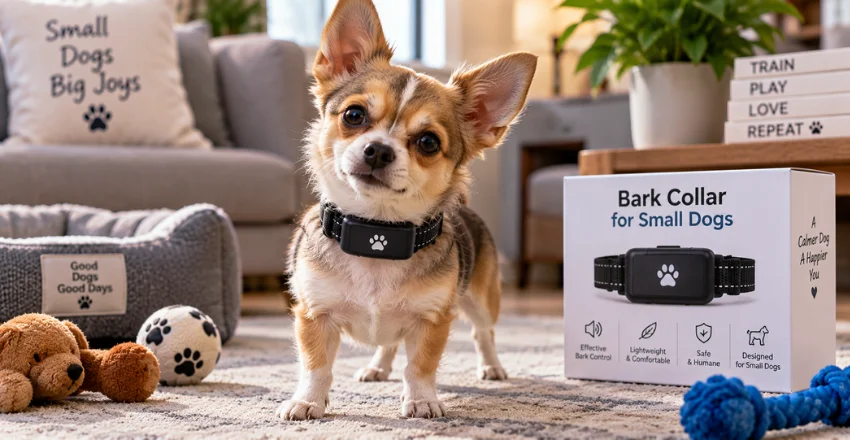
A bark collar for small dogs may seem like a quick answer when barking disrupts sleep, work, or relationships with neighbors. Small dogs need extra care because receiver weight, neck fit, correction type, and false triggering can all affect comfort. Before buying any device, it also helps to understand why your dog is barking and whether training can address the cause instead.
Direct answer: For a small dog, start with reward-based training rather than an electric correction collar. If a veterinarian or qualified trainer recommends an anti-bark device, look for a lightweight model with accurate detection, a proper neck fit, and the least intrusive correction method that works for your situation.
The American Veterinary Society of Animal Behavior recommends reward-based methods for dog training and advises against aversive methods, including electronic collars. The American Kennel Club also notes that spray, ultrasonic, and electronic bark-control tools work by adding an unwanted consequence after barking. That makes the reason behind the barking an important part of any buying decision.
Quick Comparison of Small-Dog Bark Control Options
| Bark Collar for Small Dogs | Typical small-dog fit | Method | Current U.S. information | Pros | Cons |
|---|---|---|---|---|---|
| DogRook Bark Control Collar | Dogs must weigh at least 8 lb, according to its product FAQ. | Sound + vibration | Listed at $27.99; the official store showed it sold out at the time of writing. | No electric stimulation; adjustable sensitivity | Availability is limited; vibration may still startle sensitive dogs. |
| PetSafe Spray Bark Collar | 8 lb and up; necks up to 27 in | Spray | Listed at $75.99 on PetSafe’s bark-control page | No electric stimulation; sound-and-vibration detection helps limit false activation. | Requires refill cartridges; spray is still an aversive interruption. |
| PetSafe NanoBark 2.0 | 8 lb and up; 4–15 in neck | Static stimulation | Listed at $100.99 | Compact design; automatic bark detection; waterproof | Uses electric stimulation, which AVSAB advises against |
| Reward-based training | Any healthy dog, adjusted for age and needs | Rewards + management | Cost ranges from DIY training to professional sessions. | Addresses the reason for barking; no correction device needed | Requires consistency and may take longer |
Prices and stock can change, so check the manufacturer’s current U.S. listing before purchasing. DogRook describes its unit as a 0.15-pound sound-and-vibration model, while PetSafe lists its NanoBark 2.0 for dogs weighing at least eight pounds. PetSafe’s current bark-control catalog also lists its rechargeable spray model at $75.99.
Key takeaway: Among collar-based choices, a non-electric device deserves consideration before a static model, but it shouldn’t replace training. For barking caused by anxiety, fear, boredom, or unmet needs, addressing the trigger is more useful than suppressing the sound. A veterinarian or qualified reward-based trainer can help when the cause is unclear.
What Matters More Than the Marketing Label
Terms such as “gentle,” “humane,” and “smart” appear frequently on product pages, but those words don’t tell you how your dog will respond. Look at the actual correction method, receiver weight, recommended minimum body weight, neck-size range, sensitivity controls, and shutoff features. Those details give you a clearer picture of whether a product suits a Chihuahua, Yorkie, Maltese, or another small breed.
False triggering also deserves attention, especially in apartments or multi-dog homes. Some newer products combine sound recognition with vibration sensing so another dog’s bark is less likely to activate the unit. PetSafe says its NanoBark technology identifies the wearer’s bark, while its spray models use dual detection on certain versions.
Which Type Is the Better Choice?
For most owners, our first recommendation is to work on the cause of the barking without a correction collar. AVSAB states that reward-based training should be used for behavior modification and says aversive tools aren’t more effective than reward-based methods. This is especially relevant when barking reflects fear, frustration, or separation-related distress.
If professional guidance supports trying a device, a sound-and-vibration or spray option avoids electrical stimulation. That doesn’t make these tools consequence-free, because they still interrupt barking with something the dog may dislike. Watch your dog’s body language closely, and stop if the device produces fear, freezing, avoidance, or escalating distress.
DogRook Sound-and-Vibration Collar
DogRook’s model uses beeps and several vibration levels rather than static stimulation. The company lists a weight of about 0.15 pounds, or 70 grams, and says the product is intended for healthy dogs at least six months old and eight pounds or heavier. Its U.S. product page showed the $27.99 model as sold out at the time of writing, so availability is a drawback.
PetSafe Spray Bark Collar
PetSafe’s rechargeable spray model detects barking and releases a short burst of spray. The current support information lists it for dogs eight pounds and heavier, with neck adjustment up to 27 inches. Its cartridges contain roughly 35 sprays, so ongoing refill costs should factor into your buying decision.
PetSafe NanoBark 2.0
The NanoBark 2.0 is designed for smaller dogs and fits necks from four to 15 inches. PetSafe recommends it for dogs at least eight pounds and six months old, and the U.S. listing showed a price of $100.99 at the time of writing. However, it uses automatic static stimulation, so it isn’t our recommended starting option given current veterinary-behavior guidance.
How to Choose a Bark Collar for Small Dogs Safely
Start by measuring the dog’s neck rather than buying by breed name alone. A collar designed for a 12-pound Miniature Schnauzer may still fit poorly on another dog of similar weight because neck shape and coat thickness vary. Compare your measurement with the manufacturer’s stated range before ordering.
Receiver weight matters almost as much as strap size. A large electronic module that seems insignificant on a Labrador may feel bulky on a toy breed, so favor compact hardware designed for smaller dogs. Also check the manufacturer’s minimum weight and age instead of assuming every “small dog” product works for a five-pound puppy. Elsewhere on the site: Do Dogs Know What Kisses Are.
Accurate detection is another useful feature. A device that responds to environmental noise or another dog can create confusing corrections with no clear connection to the wearer’s behavior. Models that combine sound and throat vibration may reduce that risk, although no automatic sensor should be assumed perfect.
Match the Solution to Why Your Dog Barks
| Likely barking trigger | Better first response |
|---|---|
| Attention seeking | Reward calm behavior and avoid rewarding demanding barking. |
| Boredom | Add exercise, sniffing, enrichment, and interactive play |
| Doorbell or passersby | Teach a mat, place, or quiet behavior and reward it. |
| Fear of visitors or noises | Use gradual desensitization and professional guidance. |
| Separation-related distress | Speak with a veterinarian or qualified behavior professional. |
| Sudden unexplained barking | Rule out pain, illness, hearing changes, or other medical causes. |
Barking is normal canine communication, and different causes call for different responses. The AKC recommends identifying the dog’s motivation before trying to reduce the behavior, because an anxious dog needs a different plan from a bored or attention-seeking dog. Rewarding an alternative behavior can also teach the dog what to do instead of merely stopping the noise.
Newsprest already covers the value of consistent dog training in its guide to training dogs. Although that article focuses on Albuquerque services, the broader point applies across the United States: behavior change takes repetition and clear communication. You can also browse the site’s Pets section for related pet content.
Using an Anti-Bark Device With Less Risk
If you decide to use a collar after considering training first, introduce it carefully rather than putting it on and leaving the house. Your goal should be to observe the dog’s reaction, protect the skin, and reward calm behavior whenever possible. Never attach a leash to an electronic bark-control unit because pulling can increase pressure around the contact area.
- Check the fit while your dog is standing. Follow the specific manufacturer’s placement instructions and make sure the unit isn’t constricting the neck.
- Supervise the first sessions. Watch for panic, scratching, freezing, avoidance, coughing, or unusual vocalization.
- Reward quiet behavior. Give treats, praise, play, or another valued reward when your dog settles.
- Remove the unit regularly. Check the neck for redness, sores, rubbing, or hair loss.
- Reassess the cause if barking continues. Persistent barking can signal anxiety, frustration, pain, or a training problem that a device won’t solve.
PetSafe tells owners not to leave its contact-based bark-control products on a dog for more than 12 hours per day because prolonged wear can cause skin irritation. The company also advises discontinuing use when redness or irritation appears. Treat that 12-hour figure as a manufacturer’s maximum, not a daily-wear goal.
When You Should Skip the Collar
Avoid trying to silence barking linked to separation anxiety, significant fear, aggression, or sudden behavioral change without professional help. A correction may suppress a warning signal without addressing the underlying emotional or medical issue. AVSAB recommends veterinary evaluation for serious behavior problems so you can consider medical contributors and develop a suitable treatment plan.
Puppies also need extra caution. Several major manufacturers set minimum ages around six months, and individual products also have minimum body-weight limits. A veterinarian can help if your dog falls below a product’s stated limits or has a health problem involving the neck, skin, airway, or nervous system.
Final Recommendation
For a small dog that barks excessively, begin by identifying the trigger and teaching a quieter alternative with rewards. If you still want a collar-based aid after speaking with a veterinarian or qualified trainer, favor accurate detection, low receiver weight, correct sizing, and a non-electric option before considering static stimulation. No product should replace treatment for anxiety, fear, boredom, pain, or other causes of persistent barking.
Whatever you decide about a device, barking usually improves fastest when you address the trigger at the same time. For more everyday care and home reading alongside this guide, browse the site’s Lifestyle section.
Frequently Asked Questions
Is a bark collar for small dogs safe?
Safety depends on the correction method, fit, the dog’s health, and how you use the device. Veterinary-behavior guidance favors reward-based training and advises against electronic aversive collars. If you use any automatic deterrent, supervise its introduction and stop if your dog shows distress or skin irritation.
Can I use one on a dog under eight pounds?
Many current products aren’t designed for dogs that small. PetSafe’s NanoBark 2.0 and rechargeable spray model specify a minimum weight of eight pounds, while DogRook’s current FAQ also states at least eight pounds. Don’t ignore a manufacturer’s minimum simply because the strap can physically tighten enough to fit.
Are vibration collars better than shock collars?
A vibration device avoids electrical stimulation, which removes one major concern associated with static models. Vibration can still startle or bother some dogs, so it isn’t automatically harmless. Reward-based training remains the preferred first approach under AVSAB’s current guidance.
Will a collar fix separation barking?
A device doesn’t address why a dog is distressed when left alone. Barking linked with separation problems may require behavior modification, environmental changes, veterinary assessment, or professional support. Punishing the barking can add stress without treating the underlying problem.
How long should a small dog wear one?
Follow the manual for your specific product rather than relying on a universal schedule. PetSafe warns against more than 12 hours of daily wear for several models and recommends checking the contact area for irritation. Short, supervised periods also make it easier to see how your dog responds.
