

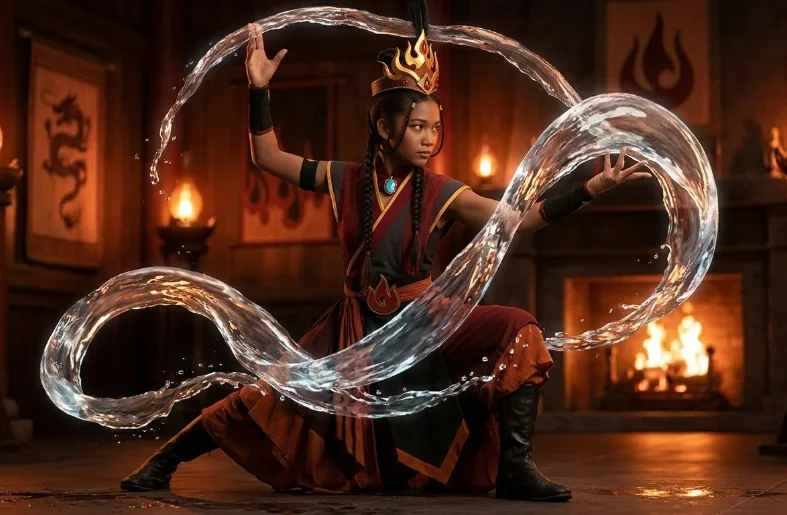
The Katara Fire Nation storyline becomes especially important during Avatar: The Last Airbender Book Three. She enters enemy territory while hiding her Water Tribe identity with Team Avatar. That experience forces her to separate ordinary citizens from the government responsible for the war.
Direct answer: The Katara Fire Nation story refers mainly to her experiences inside enemy territory during Book Three. She wears local clothing, helps civilians, confronts painful memories, and eventually fights beside Zuko. These episodes show her learning that a nation’s people are not identical to its rulers or military.
Katara’s Fire Nation Story at a Glance
| Detail | What Happens |
|---|---|
| Character | Katara, a Southern Water Tribe waterbender |
| Main setting | Fire Nation territory during Book Three |
| Early disguise | Local Fire Nation clothing used to avoid detection |
| Key episodes | “The Headband,” “The Painted Lady,” and “The Southern Raiders” |
| Important identity | The Painted Lady |
| Central conflict | Her hatred of the regime versus compassion for ordinary citizens |
| Major relationship | Her changing relationship with Zuko |
| Final payoff | She helps Zuko defeat Azula during the series finale |
What Does Katara Fire Nation Mean?
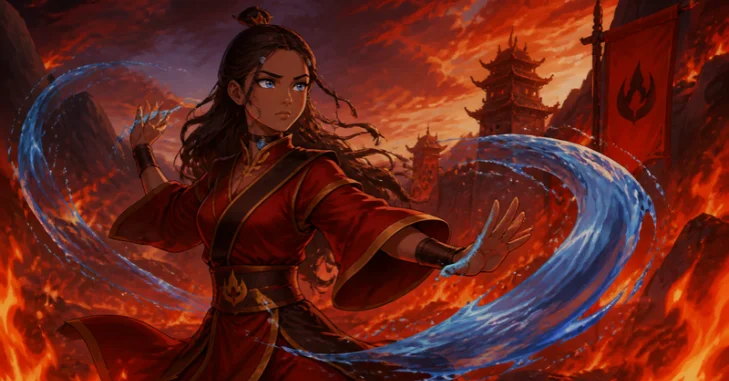
The phrase usually describes her Book Three appearance and story while Team Avatar hides inside Fire Nation territory. It can also refer to fan art showing her in the nation’s red clothing. She does not become a firebender or abandon her Water Tribe identity.
That distinction matters because her disguise serves a practical purpose. Team Avatar must avoid recognition while preparing for its next moves against Fire Lord Ozai. Paramount’s episode description for “The Headband” confirms that the group disguises itself as local citizens for camouflage.
Katara Fire Nation Her time there also creates a deeper narrative contrast. She grew up knowing the Fire Nation mainly through raids, loss, and war. Living among civilians gives her a closer view of people trapped under the same system.
Why Does Katara Wear Fire Nation Clothes?
Team Avatar enters the country after the events of Book Two. Their familiar Water Tribe, Earth Kingdom, and Air Nomad clothing would draw unwanted attention. Local clothes allow the group to move through towns with less suspicion.
“The Headband” makes this disguise central to the plot. Aang even attends a local school after being mistaken for a student. The episode shows that children inside the country also face strict rules and state-controlled ideas.
For the waterbender, the clothing creates an interesting visual change. Blue traditionally connects her with the Southern Water Tribe, while red identifies Fire Nation culture. Academic analysis of Avatar has also noted how clothing colors help code the series’ different nations.
The Painted Lady Changes How She Sees the Enemy
“The Painted Lady” is one of the most important episodes in this arc. Team Avatar reaches Jang Hui, a fishing community suffering from polluted water and widespread illness. A nearby military factory has damaged the river that supports the village.
Katara decides that leaving the villagers behind would be wrong. She secretly disguises herself as the Painted Lady, a local spirit associated with the river. She brings food to families and uses waterbending to help sick residents.
Her choice creates a crucial moral distinction. The villagers belong to the enemy nation, but they are also victims of its military system. Her compassion therefore crosses the political boundary created by the Hundred Year War.
Aang eventually learns what she has been doing and helps her. Together, they attack the factory responsible for polluting the river. The villagers later join the effort to restore their community rather than waiting for another rescuer.
Scholars have examined this episode through environmental and colonial themes. José Santos P. Ardivilla connects the story with pollution, community recovery, and resistance to imperial expansion.
Why the Painted Lady Episode Matters
The episode proves that the series does not present every citizen as an enemy. Political power and civilian identity remain separate throughout this part of Book Three. That idea prepares viewers for later changes involving Zuko.
It also reinforces the heroine’s defining instinct to help people in immediate danger. Nationality does not erase suffering in her eyes. Her anger remains aimed mainly at people and institutions responsible for harming others.
The storyline gains another layer because water heals a community damaged by industrial pollution. Waterbending becomes both a practical tool and a symbol of restoration. Her abilities protect people rather than merely defeating opponents.
Readers interested in similar character-focused pop-culture explainers can browse Newsprest’s Entertainment coverage. The site also covers canon questions in series such as My Hero Academia and One Piece. Those guides use the same distinction between confirmed story information and fan interpretation.
Her History With the Fire Nation Is Deeply Personal
Her changing outlook does not erase what happened to her family. Fire Nation raiders targeted the Southern Water Tribe while she was still a child. Her mother, Kya, died during one of those attacks.
That loss shaped her anger throughout the series. It explains why accepting Zuko becomes harder for her than for several other members of Team Avatar. She associates his homeland with one of the most painful events of her childhood.
“The Southern Raiders” eventually brings that trauma back to the surface. Zuko helps her search for Yon Rha, the former officer responsible for her mother’s death. Their journey gives her the opportunity to confront the man directly.
She ultimately refuses to kill him. That choice does not mean she suddenly forgives everything that happened. Instead, she decides that revenge will not determine what kind of person she becomes.
How Her Relationship With Zuko Changes
Zuko initially represents the enemy more personally than almost anyone else. He hunts Aang and repeatedly puts the group in danger. His later decision to oppose his father cannot instantly erase that history.
Trust develops only after actions replace promises. Helping her confront Yon Rha gives Zuko a clearer understanding of the pain caused by his country’s military campaigns. It also gives her a chance to judge him by his current choices.
Their partnership becomes significant by the finale. She fights alongside him when they confront Azula during the struggle over the throne. The former enemies now work together against the ruler continuing Ozai’s violent system.
That transformation is one reason the Book Three arc carries so much weight. The story moves from national labels toward personal responsibility. Characters become defined increasingly by what they choose to do.
For another example of separating canon from popular theories, read Newsprest’s Deku’s Dad explainer. Its structure similarly distinguishes confirmed story details from fandom speculation. That distinction is useful whenever online discussions begin mixing interpretation with official material.
Fire Nation Citizens Are Not Presented as One Group
Book Three repeatedly shows different experiences within the country. Schoolchildren, struggling villagers, soldiers, royal family members, and political leaders occupy dramatically different positions. Treating them as interchangeable would miss much of the season’s point.
Jang Hui provides the clearest example. Its residents live inside the powerful nation driving the war, yet military industry damages their health and livelihood. Their nationality does not protect them from exploitation.
This complicates the simple division between heroes and an enemy population. The government remains responsible for conquest, but individual civilians can also suffer under its decisions. That moral distinction strengthens the series’ treatment of war.
Does Katara Ever Become Part of the Fire Nation?
No, she never changes national allegiance or becomes a Fire Nation citizen in the animated series. She remains a Southern Water Tribe waterbender throughout the story. Her red clothing is primarily a disguise used while traveling through hostile territory.
She also never gains firebending. The Avatar alone can learn all four elemental disciplines as part of the reincarnation cycle. Her fighting style, healing skills, and identity remain firmly connected to water.
Fan art sometimes imagines alternate versions of the character as royalty or a permanent resident. Those interpretations can be creative, but they are not the animated series’ canon. Readers should separate those concepts from events shown on screen.
Newsprest takes a similar canon-first approach in its guide explaining how Kuina died in One Piece. That approach helps when fandom theories become more visible than the original story. It is especially useful for characters with many alternate interpretations online.
How Netflix Changes the Painted Lady Story
Netflix’s live-action adaptation makes a significant structural change to this material. The animated show places the Painted Lady storyline in Book Three, after Team Avatar enters enemy territory. Netflix moved elements of that identity into its second season instead.
Netflix’s official Tudum coverage explains that the adaptation introduces the Painted Lady earlier in Ba Sing Se. The writers use the identity while developing themes of inequality inside the Earth Kingdom capital. This means viewers should not assume both versions follow the same episode order.
The central character trait remains recognizable despite the change. She notices people suffering and feels compelled to intervene. The adaptation changes the setting and timing more than the motivation behind her actions.
Why This Story Arc Matters
The Katara Fire Nation arc works because it challenges a belief formed through understandable pain. She begins with strong personal reasons to hate the country that devastated her community. Book Three then forces her to meet people whose lives do not fit that simple category.
Her compassion does not require forgetting the war. She can condemn the regime while helping civilians harmed by its policies. That distinction gives the character more emotional and political depth.
Her relationship with Zuko follows the same pattern. She does not trust him because he asks for forgiveness. She changes her judgment after seeing what he chooses to do.
By the finale, their partnership represents one of the series’ clearest statements about responsibility. A person’s birthplace does not determine every choice they will make. Actions can either continue inherited violence or help end it.
Final Takeaway
The storyline matters because it turns enemy territory into a place filled with individual people rather than a single faceless threat. Her experiences with civilians, Zuko, and her own grief make that change believable. The result is one of Book Three’s strongest explorations of empathy without excusing injustice.
For more character histories, canon explainers, and television coverage, visit the Newsprest Entertainment section. Its related guides focus on separating confirmed information from online theories. That approach fits especially well with long-running fandoms such as Avatar: The Last Airbender.
Frequently Asked Questions
What does Katara Fire Nation mean?
The phrase generally refers to her Book Three storyline while Team Avatar hides inside enemy territory. It also describes the red local clothing she wears during this period. It does not mean she changes bending elements or permanently joins that nation.
What episode does she dress like a Fire Nation citizen?
Her disguised appearance becomes prominent at the beginning of Book Three. “The Headband,” Season 3 Episode 2, specifically centers on Team Avatar blending into local society. Paramount lists the episode as part of the show’s third season.
Why does she become the Painted Lady?
She adopts the identity to help the suffering residents of Jang Hui without immediately exposing herself. The village faces illness and hunger because pollution has damaged its river. Her disguise lets her provide aid while maintaining secrecy.
Does she forgive the man who killed her mother?
She chooses not to kill Yon Rha after confronting him in “The Southern Raiders.” That decision should not be confused with a simple declaration of forgiveness. The episode focuses more on rejecting revenge than erasing her anger.
Does she become a firebender?
No, she remains a waterbender throughout the animated story. Wearing local clothing does not alter her elemental abilities. Firebending belongs to another bending tradition that she does not learn.
Is the Netflix Painted Lady story the same as the cartoon?
No, the live-action version changes its placement and surrounding circumstances. Netflix moves the Painted Lady concept earlier and connects it with events in Ba Sing Se. The animated series places the original storyline in Book Three.
