

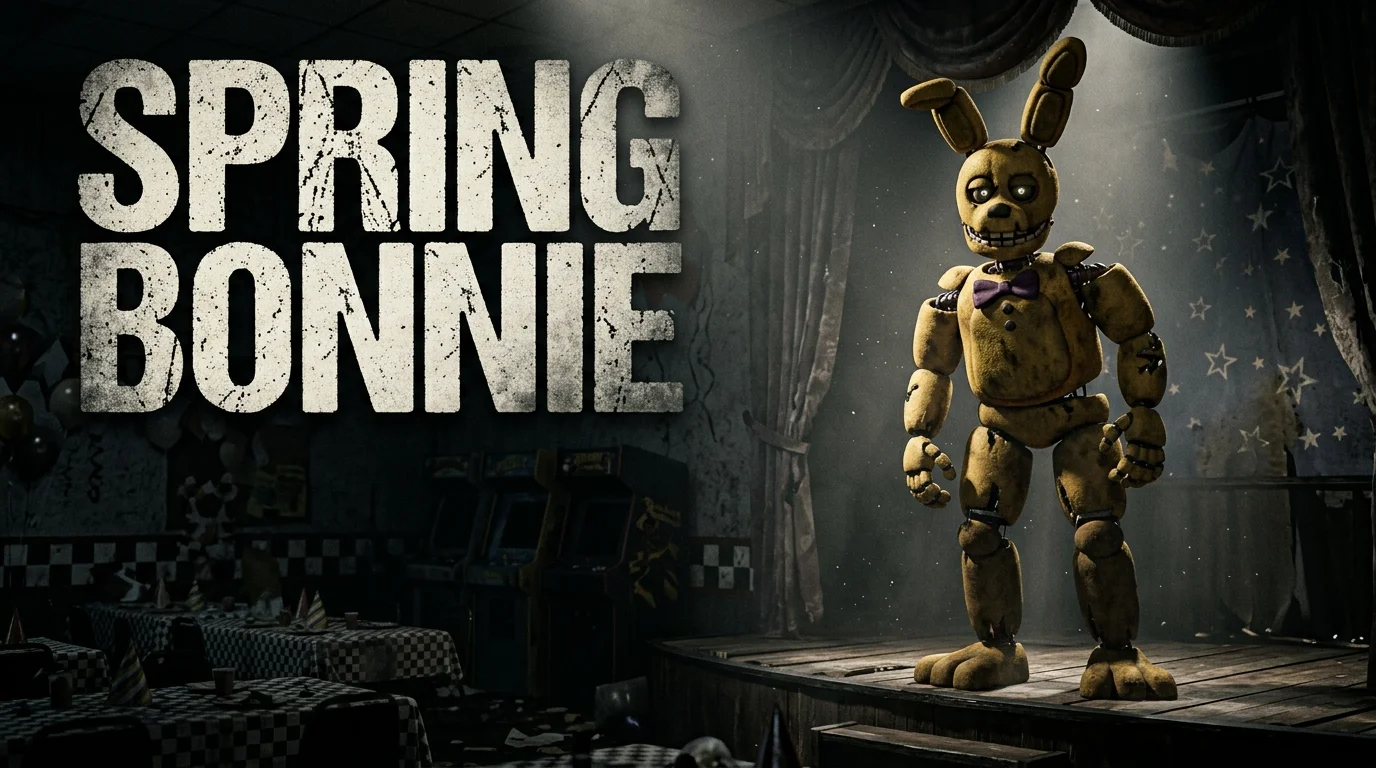
Springbonnie is the yellow rabbit character tied to some of the darkest events in Five Nights at Freddy’s. The character began as a springlock mascot associated with Fredbear’s Family Diner. Its history later became closely connected with William Afton and Springtrap.
Direct answer: Spring Bonnie is an early yellow rabbit mascot and springlock suit from the FNAF story. William Afton later uses the rabbit identity during key events in the franchise. His eventual springlock accident creates Springtrap, making the original mascot important to the series’ larger story.
| Detail | Answer |
|---|---|
| Character | Spring Bonnie |
| Franchise | Five Nights at Freddy’s |
| Type | Yellow rabbit springlock mascot |
| Associated location | Fredbear’s Family Diner |
| Closely associated character | William Afton |
| Major connection | Springtrap |
| Early game appearances | FNAF 3 and FNAF 4 material |
| Related modern title | Five Nights at Freddy’s: Into the Pit |
| Common alternate spelling | Springbonnie |
Who Is Spring Bonnie in Five Nights at Freddy’s?
Spring Bonnie is one of the earliest mascot characters in the fictional history of Fazbear restaurants. The yellow rabbit appears alongside Fredbear in material connected with Fredbear’s Family Diner. That places the character before many familiar Freddy Fazbear’s Pizza animatronics.
The mascot is especially important because it is also a wearable springlock suit. That technology allows one costume to function in more than one way. The dangerous mechanism later becomes central to William Afton’s fate.
Players don’t meet the original mascot as a standard roaming enemy in the earliest games. Much of the story appears through minigames, recordings, environmental clues, and later material. That indirect storytelling turned the character into a major subject of fan discussion.
Why Springbonnie Matters to the FNAF Story
The character matters because several major parts of FNAF history meet in one costume. It connects Fredbear’s early restaurant era with William Afton and the later Springtrap identity. Few mascot designs carry that much story importance across different periods.
Spring Bonnie also represents the franchise’s unusual approach to horror. The suit appears cheerful because it was designed to entertain children. Its mechanical design creates danger beneath that friendly appearance.
That contrast became one of the defining ideas associated with the series. FNAF repeatedly hides disturbing histories behind friendly mascots. Explore more character-focused entertainment coverage in the Newsprest Entertainment section.
What Is a Springlock Suit?
A springlock suit combines an animatronic structure with a costume that a person can wear. Internal components must be held away from the wearer when the costume enters suit mode. A mechanical failure can release those components toward the person inside.
FNAF uses that concept to explain why the older suits are unusually dangerous. Recorded messages in Five Nights at Freddy’s 3 warn employees about springlock safety. Those warnings establish that failures can cause serious injuries.
The technology also explains why Spring Bonnie differs from ordinary animatronics. It is not simply a robot standing on a stage. Under suitable conditions, a human performer can occupy the same physical shell.
Spring Bonnie and Fredbear
Spring Bonnie is commonly paired with Fredbear during the franchise’s earliest restaurant period. Both characters are associated with Fredbear’s Family Diner. Their designs also belong to the older springlock era.
Fredbear later becomes important through several other parts of FNAF lore. Spring Bonnie follows a different and darker path through William Afton. Together, they represent an earlier generation before the better-known Freddy, Bonnie, Chica, and Foxy lineup.
Five Nights at Freddy’s 4 also returns attention to this older period and its imagery. Steam lists Scott Cawthon as the game’s developer and publisher. The game originally launched on July 23, 2015.
How William Afton Is Connected to the Yellow Rabbit
William Afton is strongly associated with the Spring Bonnie costume across the franchise. The rabbit disguise becomes part of the visual language surrounding his crimes. This connection gives the once-friendly mascot a threatening meaning.
Afton’s use of the suit should not make the original mascot identical to him. Spring Bonnie begins as a character and costume within the restaurant business. Afton later uses that identity for his own purposes.
This distinction helps prevent a common lore mistake. Spring Bonnie, William Afton, and Springtrap are closely connected names. They describe different stages or identities, not one interchangeable character name.
How Spring Bonnie Becomes Connected to Springtrap
Springtrap is the damaged rabbit animatronic encountered in Five Nights at Freddy’s 3. The character contains William Afton after a catastrophic springlock failure. This event permanently links Afton with the deteriorated rabbit suit.
That means Springtrap isn’t simply a cleaned-up version of the original restaurant mascot. He represents the horrific result of the suit, Afton, and the springlock accident coming together. The decayed appearance reflects years of damage and abandonment.
Understanding that sequence makes later FNAF references easier to follow. The yellow mascot represents an earlier stage in the story. Springtrap represents what remains after Afton’s fatal encounter with the mechanism.
Spring Bonnie Across the Games
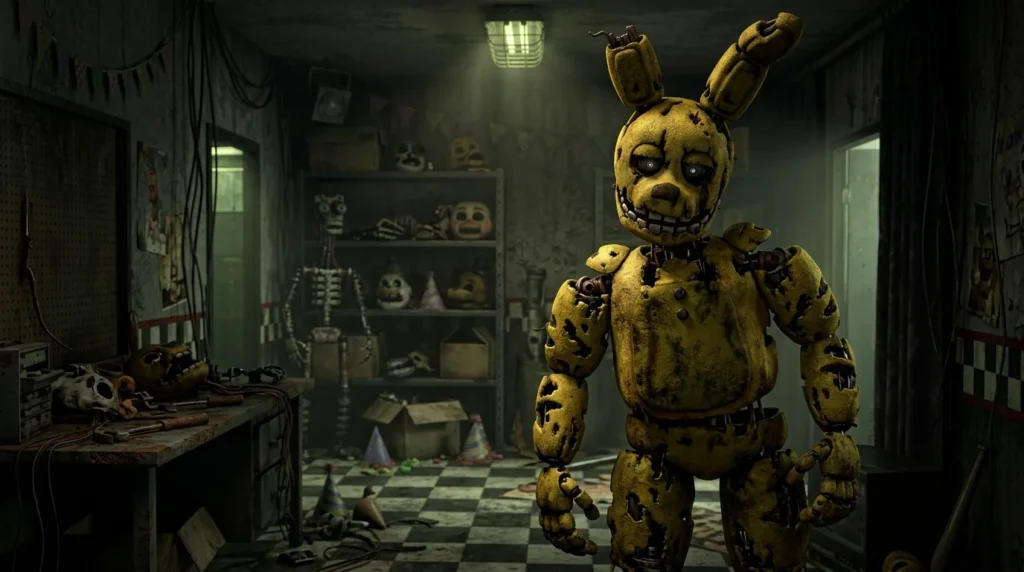
The original character often appears indirectly rather than as a polished, full-body gameplay model. FNAF uses minigames and background storytelling to establish much of the mascot’s history. This limited presentation encouraged many fan-made interpretations.
Five Nights at Freddy’s 3 is especially important because its recordings discuss springlock suits and related safety problems. The game also establishes the Springtrap storyline that makes the older rabbit costume significant. Later titles offer more visual and narrative references to the restaurant’s earlier era.
Fans who want more gaming coverage can visit the Newsprest Gaming section. The site also covers fan-theory questions from other major franchises. Its guide explaining Kuina’s death in One Piece uses a similar canon-versus-theory approach.
What Is the Into the Pit Version?
Five Nights at Freddy’s: Into the Pit introduces a yellow-rabbit threat into Oswald’s story. Mega Cat Studios developed and published the game. It released on August 7, 2024, according to its Steam listing.
This version shouldn’t be treated as the standard restaurant suit from every other FNAF appearance. Into the Pit uses its own story context and presentation. Fans often use terms such as “Pit Bonnie” or “Pittrap” when discussing this variation.
The distinction matters because FNAF includes games, books, adaptations, and related continuities. Similar appearances don’t always mean every version follows the same rules. Careful readers should separate confirmed details from fan interpretations.
Spring Bonnie vs. Springtrap vs. Into the Pit Rabbit
| Character or version | Basic identity | Main distinction |
|---|---|---|
| Spring Bonnie | Early yellow rabbit mascot | Original springlock-era character and suit |
| William Afton | Human character | Uses the rabbit identity during key events |
| Springtrap | Afton trapped within a damaged rabbit suit | Later decayed form |
| Into the Pit rabbit | Yellow rabbit antagonist | Appears within the Into the Pit storyline |
These names become confusing because they share visual features and story connections. Fans also use informal nicknames that are not always official character names. Checking the specific game, book, or adaptation usually resolves the confusion.
The safest approach is to identify the version before interpreting the story. A yellow rabbit image alone may not reveal which continuity or period is being shown. Context usually matters more than color or costume shape.
What Does Spring Bonnie Look Like?
The character is generally represented as a yellow or golden rabbit mascot. Common features include long rabbit ears and a purple bow tie. Different appearances may adjust proportions, facial details, or coloring.
Fans have created countless detailed models because the earlier games leave room for interpretation. Those unofficial designs sometimes appear so polished that viewers mistake them for official models. That can create confusion when comparing screenshots or videos.
The design’s basic idea remains consistent despite those variations. It pairs a cheerful restaurant mascot with machinery that can become dangerous. That contrast explains much of the character’s enduring appeal.
Why Fans Still Debate the Character
FNAF rarely explains its history through a simple chronological narrative. Players often reconstruct the story from recordings, minigames, visual clues, and later releases. That structure naturally creates different interpretations.
The spelling also sparks occasional fan discussion. Fans commonly use “Spring Bonnie” when referring to the character by name. “Springbonnie” remains popular in searches, fan discussions, models, and other online content.
Debate becomes less reliable when theories are presented as confirmed information. A useful lore guide should clearly label speculation and separate different continuities. Newsprest uses the same approach in its fictional-character explainers.
Is Spring Bonnie the Same as Glitchtrap?
Spring Bonnie and Glitchtrap share obvious rabbit imagery, but the names aren’t synonyms. Glitchtrap belongs to a later section of the franchise involving digital threats and different story questions. The original yellow mascot comes from the earlier restaurant history.
Their similarities encourage theories about symbolism and identity. Those theories can be interesting without erasing the differences between each version. The exact source material should guide any comparison.
The same rule works throughout FNAF. Similar rabbit designs often signal thematic connections. They don’t automatically prove two characters are physically identical.
Frequently Asked Questions
Who is Springbonnie in FNAF?
Spring Bonnie is an early yellow rabbit mascot associated with Fredbear’s Family Diner. The character is connected with dangerous springlock technology and William Afton. This connection eventually becomes central to Springtrap’s creation.
Is Spring Bonnie William Afton?
No, the mascot itself begins as a character and springlock costume. William Afton later uses the rabbit suit or identity during important story events. Treating the mascot and the human character as identical removes that distinction.
Is Spring Bonnie the same as Springtrap?
They are closely connected, but the names describe different states. Springtrap is associated with Afton after the springlock suit fails. Spring Bonnie represents the earlier mascot and costume before that transformation.
What color is Spring Bonnie?
The mascot is generally depicted as yellow or golden. Purple accessories commonly appear with the rabbit design. Exact visual details can change between representations and adaptations.
Is the Into the Pit rabbit Spring Bonnie?
The Into the Pit antagonist uses Spring Bonnie imagery and is commonly identified with that name. Its story context differs from the original restaurant mascot’s straightforward historical role. Readers should avoid combining every detail from both versions automatically.
When did Spring Bonnie first become important in FNAF?
The character’s history became especially important through Five Nights at Freddy’s 3. That game provides major information about springlock suits and Springtrap. Later releases expanded fans’ understanding of the earlier yellow rabbit.
Why the Character Remains Important
Spring Bonnie sits near the center of FNAF’s transition from family entertainment to horror. The mascot connects the earliest restaurant period with Afton’s actions and Springtrap’s creation. It also helps explain why springlock technology matters throughout the story.
The character remains popular because many details are presented through fragments rather than direct exposition. Every later rabbit design invites fans to compare timelines, identities, and visual clues. That mystery keeps the older mascot relevant even years after its introduction.
For more gaming and entertainment explainers, browse Newsprest and its growing collection of story guides. Look for articles that separate confirmed source material from fan theory. That distinction is especially useful with a franchise as complicated as FNAF.
—–
