

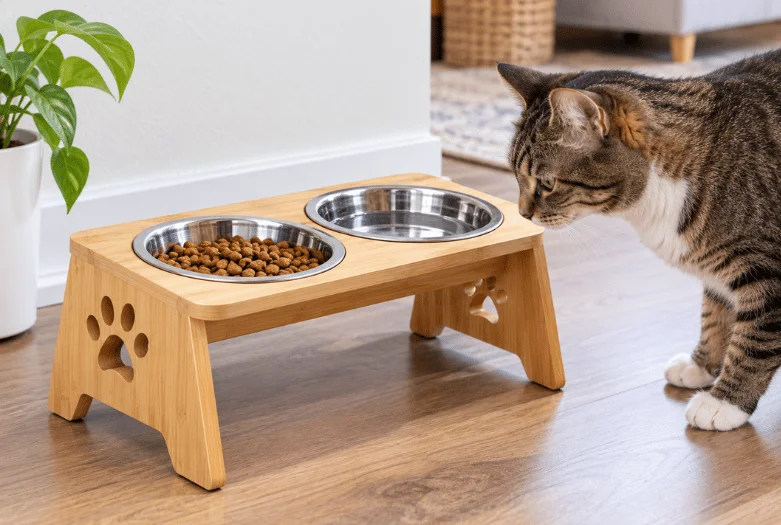
Elevated cat bowls can make meals easier for some cats, especially seniors with stiffness or limited mobility. They are not proven treatments for vomiting, reflux, or digestive disease. The right choice depends on your cat’s comfort, eating style, and the bowl’s stability.
Raised feeding dishes can reduce how far a cat lowers its head during meals. That change may feel more comfortable for older cats or cats with sore joints. Healthy cats may gain no clear medical benefit, so choose a stable, wide dish and judge the result by your cat’s behavior.
Quick Facts Before You Buy
| Question | Practical answer |
|---|---|
| Who may benefit most? | Senior cats, cats with mobility limits, and cats that prefer a higher feeding position. |
| Do raised dishes stop vomiting? | No reliable evidence proves that bowl height prevents vomiting in healthy cats. |
| What height works best? | There is no universal veterinary standard. Start with a modest lift that avoids deep crouching or upward reaching. |
| What shape is useful? | Wide, shallow dishes often give the face and whiskers more room. |
| What materials are practical? | Food-grade stainless steel and sound, glazed ceramic are durable and easy to clean. |
| What do U.S. options cost? | Common listings currently start around $10, while many standard designs fall below $30. Premium systems can cost more. |
TL;DR
- Raised dishes may improve comfort for senior or mobility-limited cats, but they are not proven medical treatments.
- Start with a stable, wide, shallow design and a modest height your cat can reach easily.
- Repeated vomiting, weight loss, or eating difficulty belongs with a veterinarian, not a feeding accessory.
Are Elevated Cat Bowls Good for Cats?
They can be useful, but they are not automatically better for every cat. Vet-reviewed sources note that direct scientific evidence on raised feeding for cats remains limited. That makes individual preference and mobility more important than broad marketing claims.
A healthy adult cat may eat comfortably from a floor-level dish for years. A senior cat with arthritis may prefer less neck and shoulder flexion during meals. Cats.com also found its test cats generally preferred wider, shallower dishes during product testing.
Which Cats May Benefit Most?
Older cats are the clearest group to consider for a raised feeding setup. Joint stiffness can make repeated crouching less comfortable, even when a cat still walks normally. A modest lift may reduce how far the head and front body must lower.
Cats recovering from surgery or living with mobility limits may also need easier access to food. Your veterinarian can help choose a feeding position when pain or orthopedic disease is involved. Height should support normal eating, not force the cat to stretch upward.
Young, healthy cats often have no medical reason to use a raised dish. Some still prefer one, while others ignore it or eat faster from it. Treat the bowl as a comfort choice unless your veterinarian recommends it for a specific condition. The same judgment applies to other comfort-driven pet gear, as our small-dog bark collar guide shows.
Do Raised Bowls Stop Vomiting?
Marketing often describes raised dishes as “anti-vomiting” products, but the evidence does not support that promise. PetsRadar’s veterinary review says studies have not validated claims about improved digestion or reduced vomiting. Chewy also advises choosing elevation for comfort rather than as a medical treatment.
Fast eating can cause problems that bowl height will not solve. A shallow slow feeder, smaller meals, or another feeding strategy may fit that pattern better. Persistent vomiting, weight loss, trouble swallowing, or appetite changes require veterinary attention.
Compare the Main Raised Bowl Designs
| Design | Best suited to | Advantages | Tradeoffs |
|---|---|---|---|
| Ceramic pedestal | Cats needing stability | Heavy, steady, often wide and shallow | Can chip or break if dropped |
| Stainless bowl with stand | Owners prioritizing durability | Easy cleaning and replaceable parts | Stand quality determines wobble and noise |
| Tilted raised bowl | Cats that push food toward the rim | Food gathers toward one side. | Tilt does not guarantee better digestion. |
| Raised slow feeder | Fast eaters | Combines height with pacing features | Deep grooves may frustrate some cats. |
| Double-bowl station | Compact feeding areas | Keeps dishes together and organized | Food can spill into nearby water. |
For many homes, a stable ceramic pedestal or stainless bowl with a solid stand is the simplest choice. The dish should stay put when your cat leans into it. Decorative height matters less than stability, usable width, and easy cleaning.
Current U.S. listings show many common raised models between about $10 and $30. Chewy listings in September 2026 include budget pairs near $10 and several standard designs around $14 to $25. Larger or premium feeding systems can cost more, so compare construction before paying for styling.
How High Should a Raised Cat Dish Be?
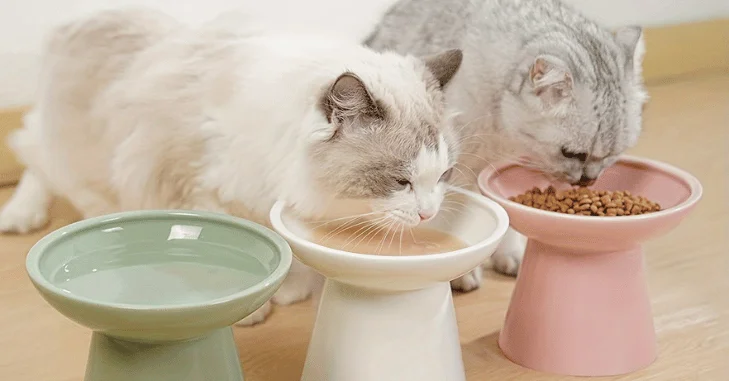
There is no single veterinary-backed height that fits every cat. Commercial models often raise food by a few inches, but body size varies widely. Start low enough that your cat can eat without lifting the chin or stretching the neck.
A practical trial can help before you buy an expensive stand. Place the familiar dish on a firm, non-slip platform and watch several meals. Stop if the setup wobbles, your cat avoids food, or the new position looks awkward.
Judge the height by posture rather than by a number on a product page. The neck should look relaxed, and the front legs should not brace against the stand. Your cat should reach the full meal without leaning sharply downward or upward.
Shape and Material Matter as Much as Height
Wide, shallow dishes give a cat more room to reach food without pressing deeply into a narrow bowl. The phrase “whisker fatigue” is common in product marketing, but the evidence remains limited. Choosing a wider shape is still a low-risk way to test whether bowl contact affects eating behavior.
Food-grade stainless steel is durable, washable, and difficult to break. Glazed ceramic is heavier, which can help prevent sliding, but damaged glaze or chips need attention. Plastic is light and inexpensive, yet scratches can make cleaning harder over time.
Whatever material you choose, clean the dish consistently. Wet food residue should not sit for long periods, and water dishes also need routine washing. A removable bowl usually makes daily cleaning easier than a complicated fixed stand.
7 Ways to Choose the Right Feeding Setup
- Watch your cat first. Notice crouching, hesitation, head turning, food scattering, or repeated pauses.
- Choose stability before style. Look for weight, a wide base, or non-slip feet that prevent movement.
- Favor a wide, shallow dish. Easy access often matters more than extra height.
- Start with modest elevation. Your cat should not need to reach upward for food.
- Match the design to the problem. Fast eaters may need pacing features instead of more height.
- Check cleaning instructions. Removable, dishwasher-safe parts can make daily care simpler.
- Trial the change. Keep the food familiar and watch whether posture, intake, and mess improve.
Our Practical Recommendation
For most healthy cats, a raised dish is optional rather than essential. If your cat already eats comfortably, you do not need to change the setup. Spend first on a stable, washable dish with enough width for easy access.
For a senior or stiff cat, a modestly raised, wide, shallow feeder is worth trying. Choose a stable base and observe several meals before judging the change. If comfort improves without reducing intake, the setup is doing useful work.
For cats that gulp food, start with feeding speed rather than height. A slow feeder or smaller portions may address the actual problem more directly. Choose shallow grooves for wet food so your cat can still reach the meal.
When a Vet Should Be Involved
A bowl change should never replace medical evaluation for repeated vomiting or eating difficulty. Weight loss, reduced appetite, drooling, swallowing trouble, or obvious pain also deserve veterinary advice. These signs can have causes that no feeding accessory can correct.
Sudden behavior changes matter even when your cat still eats something. A cat that starts eating sideways, dropping food, or walking away may have dental or mobility discomfort. Your veterinarian can assess the cause before you keep changing products.
More Pet-Care Reading on Newsprest
- Browse the Newsprest Pets section for more pet-care guides.
- See the Albuquerque dog-training guide for broader pet routine and training ideas.
Frequently Asked Questions
Are elevated cat bowls good for every cat?
No, healthy cats may not need a raised feeding surface. Some cats prefer the higher position, while others prefer floor-level dishes. Use your cat’s posture, appetite, and comfort as the deciding signals.
Can a raised dish reduce vomiting?
It might help an individual cat, but there is no strong evidence that elevation prevents vomiting. Repeated vomiting should be discussed with a veterinarian rather than managed through bowl changes alone. Fast eaters may benefit more from pacing strategies.
What height should a raised food bowl be?
No universal height works for every cat. Start with a modest lift that reduces deep crouching without making the cat reach upward. A stable trial using the familiar dish can show whether the change helps.
Are tilted bowls better than level bowls?
A tilt can keep food gathered near the lower edge of the dish. That may help cats that push food around or leave pieces at the far rim. It does not prove better digestion or prevent medical problems.
Is ceramic or stainless steel better?
Both can work well when they are food-safe and easy to clean. Ceramic offers weight and stability, while stainless steel offers durability and lower breakage risk. The better choice is the one your cat uses comfortably and that you can clean consistently.
Choose Comfort, Then Watch the Cat
The best feeding setup is the one your cat can use comfortably, safely, and consistently. Height can help some older or stiff cats, but it is only one part of good bowl design. Stability, width, material, and cleaning also shape the daily experience.
Start with a simple trial and make one change at a time. Watch posture, food intake, meal speed, and mess over several days. If symptoms appear or appetite changes, move from product testing to veterinary care.
