


Seeing a P2096 code after scanning your check-engine light can point to several different problems. It means the engine computer detects a lean condition after the catalytic converter on Bank 1. The fault deserves diagnosis because replacing the oxygen sensor without testing can waste money. Direct answer: P2096 means “Post Catalyst Fuel Trim System Too Lean Bank 1.” The engine computer sees more oxygen than expected in the exhaust after the catalytic converter. Common causes include exhaust leaks, intake leaks, fuel-delivery problems, sensor faults, wiring issues, or vehicle-specific software problems.
| Key fact | What U.S. drivers should know |
|---|---|
| Code definition | Post Catalyst Fuel Trim System Too Lean, Bank 1 |
| Code type | Generic OBD-II powertrain trouble code |
| Main system | Fuel mixture and emissions monitoring |
| Bank 1 | Engine side containing cylinder number one |
| Common warning | Check-engine light |
| Possible causes | Exhaust leak, intake leak, fuel problem, sensor issue, wiring, software |
| Driving risk | Often moderate, but diagnosis should not be delayed |
| First step | Scan all stored codes and inspect for leaks |
Key Takeaways
* The fault does not automatically prove the downstream oxygen sensor is bad. * Exhaust leaks can introduce oxygen and create a misleading lean reading. * Intake leaks or weak fuel delivery can cause a genuine lean mixture. * Related trouble codes can help identify the real problem faster. * Manufacturer service information should guide final testing and repair. * A flashing check-engine light or severe misfire requires immediate attention.
What Does the P2096 Code Mean?
The official definition describes a post-catalyst fuel-trim condition that is too lean on Bank 1. “Lean” means the exhaust contains more oxygen than the computer expects. The powertrain control module uses sensor feedback to recognize that condition. Bank 1 is the cylinder bank containing cylinder number one. Inline engines normally have only one cylinder bank. V-type and flat engines can have separate Bank 1 and Bank 2 systems. The “post catalyst” wording is also important. It identifies monitoring associated with the exhaust after the catalytic converter. It does not mean the catalytic converter itself has definitely failed. OEM diagnostic information confirms that several systems can produce the same fault. Nissan documentation, for example, lists sensors, fuel pressure, injectors, intake leaks, and exhaust leaks as possible causes. This range explains why diagnosis should happen before parts replacement.
Common Causes of the P2096 Code
Several problems can make the exhaust appear lean after the catalytic converter, and the Newsprest Automobile section covers broader vehicle topics. Some create a genuinely lean mixture, while others affect the sensor reading. The most common possibilities should be checked before expensive components are replaced. The most common causes are listed here.
* Exhaust leaks before or near the downstream oxygen sensor. * Vacuum or unmetered-air leaks. * Low fuel pressure. * Restricted or failing fuel delivery. * Dirty or inaccurate mass airflow readings. * Faulty air-fuel ratio or oxygen sensors. * Damaged sensor wiring or connectors. * Fuel-injector problems. * Catalytic-converter problems. * Powertrain control module software issues.
An exhaust leak deserves early attention because outside air contains oxygen. That oxygen can reach the sensor and make the exhaust appear leaner. A damaged gasket, cracked pipe, or leaking connection can therefore trigger misleading readings. Fuel problems can create a real lean condition instead. Low pressure or restricted delivery can leave the engine without enough fuel. Intake leaks can also introduce air that the computer did not measure. Software should not be ignored on certain vehicles. Volkswagen issued technical guidance covering P2096 among faults that could involve updated ECM software. Vehicle-specific service bulletins can therefore change the correct diagnostic path.
What Symptoms Can You Notice?
A check-engine light is usually the most obvious symptom. Some vehicles continue driving almost normally despite the stored fault. Others develop noticeable performance or fuel-economy problems. Possible symptoms include:
* Illuminated check-engine light * Rough idle * Hesitation * Poor acceleration * Lower fuel economy * Engine misfires * Unusual exhaust odors * Reduced engine performance * Additional lean-mixture trouble codes
Symptoms vary because the underlying cause varies. A small exhaust leak may produce few driving problems. A fuel-delivery issue can create much stronger symptoms. O’Reilly and AutoZone both identify performance problems and reduced fuel economy among possible symptoms. AutoZone also lists rough idle and misfires. Those symptoms should be considered clues rather than proof of one failed component.
Is P2096 Serious, and Can You Keep Driving?
This fault is generally more urgent than a harmless stored history code. The vehicle may remain drivable when performance feels normal. Continuing for a long period without diagnosis is still a poor choice. A genuine lean condition can affect combustion and emissions. An exhaust leak can worsen and may create noise or other problems. Sensor or fuel-system faults can also lead to additional trouble codes. Stop driving sooner if the check-engine light flashes. You should also stop for severe misfires, major power loss, overheating, or unsafe engine behavior. Those signs can indicate a problem beyond this diagnostic code alone. For a steady warning light and normal vehicle behavior, arrange diagnosis promptly. Avoid assuming that clearing the fault solves anything. The light usually returns if the underlying problem remains.
How to Diagnose the P2096 Code
Good diagnosis follows evidence instead of replacing the most obvious part. Start with basic checks that can identify common causes quickly. Move toward sensor testing only after simpler problems are excluded.
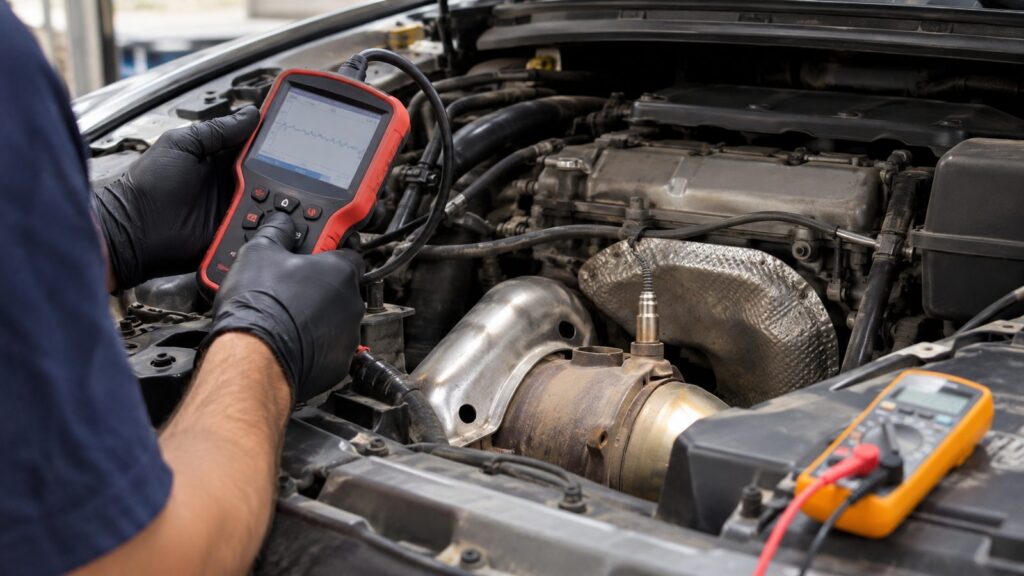
1. Scan every stored trouble code
Record all current, pending, and history codes before clearing anything. Related lean, misfire, airflow, or catalyst codes may change the diagnostic direction. Freeze-frame information can also show the conditions present when the fault appeared.
2. Inspect the exhaust system
Check the exhaust for leaks before and around the relevant sensors. Look for damaged gaskets, cracks, loose connections, or corrosion. A small leak can introduce enough oxygen to affect sensor readings.
3. Check for intake or vacuum leaks
Inspect hoses, intake connections, and other possible unmetered-air sources. Extra air entering after airflow measurement can produce lean fuel corrections. Smoke testing can help locate leaks that are difficult to see.
4. Review fuel-trim data
A capable scan tool can display short-term and long-term fuel corrections. Large positive corrections may support evidence of a lean condition. Always compare readings with the vehicle manufacturer’s specifications.
5. Check fuel delivery
Verify fuel pressure when the service procedure calls for that test. Inspect injectors or fuel-delivery components if the evidence points toward insufficient fuel. Do not replace a fuel pump based only on this code.
6. Test oxygen and air-fuel sensors
Check sensor signals, heaters, wiring, connectors, and reference values. A sensor can fail, but its reading may also be accurately reporting another problem. Manufacturer procedures provide the correct test values for each vehicle.
7. Check service bulletins and software
Search technical service information for the exact year, make, model, engine, and calibration. Some manufacturers have published software-related guidance involving this fault. Following an applicable bulletin can prevent unnecessary parts replacement.
P2096 Code vs. P0171 and P0420
Drivers sometimes confuse this fault with other familiar emissions codes. The meanings overlap, but they are not interchangeable. Understanding the distinction can prevent an incorrect diagnosis.
| Code | Basic meaning | Main diagnostic focus |
|---|---|---|
| P2096 | Post-catalyst fuel trim too lean, Bank 1 | Downstream mixture monitoring |
| P0171 | System too lean, Bank 1 | Main engine fuel mixture |
| P0420 | Catalyst efficiency below threshold, Bank 1 | Catalytic-converter efficiency |
P0171 usually focuses more directly on the engine running lean before the catalyst. P0420 focuses on whether the catalytic converter meets expected efficiency. The post-catalyst fault can appear beside either code, making companion codes especially useful. The distinction also explains why replacing the catalytic converter immediately can be expensive and unnecessary. A leak or sensor problem can create misleading exhaust information. Always diagnose the complete code set before choosing a repair.
How Much Can the Repair Cost?
Repair cost depends entirely on the failed part and local labor rates. A loose connection or small exhaust leak can cost far less than a converter replacement. Proper testing is therefore part of controlling repair costs. The usual repair categories are listed here.
* Exhaust gasket or leak repair. * Vacuum hose or intake repair. * Oxygen-sensor replacement. * Wiring or connector repair. * Fuel-system diagnosis and repair. * Injector service or replacement. * Catalytic-converter replacement. * ECM software update or reprogramming.
Ask the shop to explain which test confirmed the failed component. A diagnostic code identifies a system condition rather than a guaranteed bad part. That distinction matters when expensive emissions components are involved.
Can You Fix This Problem Yourself?
Some checks are reasonable for experienced DIY owners. You can inspect visible hoses, wiring, connectors, and obvious exhaust damage. You can also scan codes and review live data with suitable equipment. More advanced testing may require a smoke machine, fuel-pressure equipment, electrical meters, or manufacturer scan data. Exhaust components can also become hot enough to cause serious burns. Work only on a safely supported and cooled vehicle. Readers interested in technology can also explore the Tech section. Newsprest also has background material on catalysts in manufacturing for readers interested in catalyst chemistry.
Frequently Asked Questions
What does the P2096 code mean in simple terms?
The P2096 code means the vehicle detects a lean exhaust condition after the catalytic converter on Bank 1. The computer is seeing more oxygen than expected. The cause can involve air leaks, fuel delivery, sensors, wiring, or software.
Does this code mean the oxygen sensor is bad?
No, a stored fault does not prove the oxygen sensor has failed. The sensor may be correctly reporting an exhaust or mixture problem. Testing the system before replacement avoids unnecessary repairs.
Can an exhaust leak cause it?
Yes, an exhaust leak can introduce outside oxygen into the exhaust stream. That extra oxygen can affect downstream sensor readings. Inspecting for leaks is therefore an important early diagnostic step.
Can a catalytic converter cause the problem?
A converter problem can be involved, but it is not the only possibility. Sensor, leak, fuel, or wiring issues can produce similar evidence. Confirm converter failure before approving an expensive replacement.
Will clearing the code fix the problem?
Clearing the code only removes stored diagnostic information. It does not repair the condition that triggered the warning. The fault can return after the vehicle completes its monitoring tests.
Is Bank 1 always the driver’s side?
No, Bank 1 means the side containing cylinder number one. Its physical location varies by engine design and manufacturer. Check reliable service information for your exact engine.
The Best Next Step
Begin with a full scan and save every stored code before clearing anything. Then inspect the exhaust and intake systems for leaks. These checks can reveal common causes without immediately buying replacement parts. If basic inspection does not find the problem, use manufacturer-specific diagnostic information. Test fuel delivery, sensors, wiring, and applicable software in the recommended order. That approach is safer and usually cheaper than guessing. A qualified repair shop can help when live-data interpretation or specialized testing is required. Ask for the test results supporting any recommended replacement. Evidence-based diagnosis gives you the best chance of fixing the fault correctly the first time. —
